6R80 Harsh Shifting
6R80 Harsh Shifting Explained – Why Ford Ranger Gearboxes Start Jerking or Slamming Gears
Many Ford Ranger owners first notice something is wrong with their transmission not because the vehicle stops driving, but because the gearbox begins to shift harshly. Instead of smooth gear changes, the transmission may jerk, thump, slam into gear, or hesitate briefly before engaging.
These symptoms often appear gradually. At first the shift may feel slightly firmer than usual. Over time it becomes more noticeable, especially during the 2–3 or 3–4 gear change, or when selecting Drive or Reverse. Some owners describe the feeling as the gearbox “thinking” before engaging, followed by a sudden grab.
A typical example is a Ranger that drives normally for the first few minutes, then begins to jerk or thump between gears once the transmission warms up. Many owners assume the vehicle simply needs a service, but in reality this behaviour often indicates pressure control instability inside the 6R80 valve body.
In most cases, harsh shifting in the Ford 6R80 transmission is not immediately caused by mechanical failure of clutch packs or gears. Instead, it usually begins as a hydraulic control problem inside the valve body, where the transmission regulates pressure and shift timing.
The 6R80 transmission is used in Ford Ranger PX1, PX2 and early PX3 models. Because these vehicles are commonly used for towing, touring and commercial work in Australia, harsh shifting symptoms appear frequently as the transmission accumulates heat cycles and hydraulic wear. These models represent the majority of Rangers currently operating across Australia, which is why harsh shifting complaints from 6R80 transmissions are so common among Ranger owners.
Understanding why harsh shifting happens requires understanding how the 6R80 performs a gear change and why this transmission is particularly sensitive to pressure control accuracy.
What Causes Harsh Shifting in the Ford Ranger 6R80?
Harsh shifting in the Ford Ranger 6R80 transmission is usually caused by hydraulic pressure instability inside the valve body. When pressure control becomes inconsistent due to valve body wear, solenoid drift or degraded transmission fluid, the clutch packs apply too aggressively and gear changes feel abrupt or jerky.
Symptoms Owners Notice Before the Gearbox Fails
Harsh shifting often appears long before the transmission throws diagnostic codes or begins slipping. This early stage can last thousands of kilometres if the underlying cause is not addressed.
Common symptoms owners report include:
Hard or abrupt shift between gears, particularly from 2nd to 3rd
Noticeable jerk or thump when accelerating normally
The transmission banging into gear when selecting Drive or Reverse
A brief hesitation followed by a sudden engagement
Gear changes that feel firmer or more aggressive than normal
Shifts that worsen after the transmission warms up
Some Rangers may also show inconsistent behaviour, shifting smoothly one moment and harshly the next. This inconsistency is often an early sign that the transmission control system is struggling to maintain stable hydraulic pressure.
Because these symptoms appear before major mechanical damage occurs, many drivers assume the behaviour is normal or simply part of how the vehicle drives. In reality, harsh shifting is often the first warning sign that hydraulic control inside the transmission is beginning to deteriorate.
Why the 6R80 Is Sensitive to Hydraulic Control Problems
The 6R80 transmission is very different from older automatic gearboxes that relied mainly on simple hydraulic switching. Instead, the 6R80 uses a mechatronic control system that combines electronic software with hydraulic pressure modulation.
At the centre of this system are pulse-width modulated (PWM) solenoids inside the valve body. These solenoids regulate fluid pressure with extremely fine precision, allowing the transmission control module (TCM) to adjust shift behaviour continuously.
The TCM constantly monitors several signals:
Engine speed
Turbine speed
Output shaft speed
Throttle position
Transmission temperature
Using this information, the TCM calculates how quickly each clutch must apply and how much pressure is required to achieve a smooth gear change.
During normal operation the 6R80 torque converter clutch may operate with controlled slip of roughly 20–50 RPM during light throttle cruising.
The system also uses adaptive learning strategies. Over time, the transmission adjusts clutch fill times and pressure ramps to compensate for normal wear inside the gearbox. This allows the vehicle to maintain smooth shifts even as components age.
However, this design also means the 6R80 is very sensitive to hydraulic instability.
If pressure control becomes inconsistent due to valve body wear, solenoid drift, or fluid degradation, the TCM begins compensating aggressively. When those corrections exceed the system’s adaptive range, shift quality deteriorates and harsh engagement becomes noticeable.
In other words, harsh shifting is often the result of the control system fighting to maintain proper pressure behaviour.
How Gear Changes Actually Occur Inside the 6R80
To understand harsh shifting properly, it helps to understand how a gear change actually occurs inside the transmission.
Each shift in the 6R80 is an overlap event. One clutch pack is releasing while another clutch pack is applying. The valve body must carefully control hydraulic pressure so the transition between the two clutches occurs smoothly.
If the releasing clutch lets go too quickly while the applying clutch is still filling, the transmission experiences flare, where engine speed rises briefly between gears.
If the applying clutch engages too aggressively before the releasing clutch has fully disengaged, the transmission produces a harsh or abrupt shift.
The valve body controls this process using a combination of:
shift solenoids that route hydraulic circuits
pressure control solenoids that regulate clutch apply force
a pressure regulator circuit that maintains baseline line pressure
EPC (electronic pressure control) solenoid regulating baseline line pressure
The TCM constantly adjusts the pressure ramp rate for each shift to achieve the desired behaviour.
In simple terms, the transmission is attempting to shape torque transfer between gears. If the hydraulic system cannot maintain stable pressure, that carefully timed choreography breaks down.
When pressure arrives too quickly or too aggressively, the clutch engages abruptly and the driver feels a hard shift or thump.
The Most Common Causes of Harsh Shifting in the 6R80
Several conditions can cause the 6R80 transmission to begin shifting harshly. Most of them relate to loss of hydraulic precision inside the valve body.
One common cause is valve body wear. Over time, hydraulic pressure can leak past worn valve bores, especially in the pressure regulator and clutch control circuits. Even small leaks reduce the system’s ability to maintain stable pressure during clutch application.
Another common issue is solenoid performance drift. The solenoids in the 6R80 rarely fail completely, but their response time and flow characteristics can change with age and heat. This reduces the accuracy of pressure control and affects shift timing.
Separator plate fatigue can also contribute to pressure loss. The separator plate directs hydraulic fluid through different circuits, and over time the plate can deform or allow cross-leaks between channels.
Fluid condition plays a major role as well. As ATF ages and is exposed to high temperatures, its viscosity decreases. Thinner fluid cannot maintain the same hydraulic pressure levels, particularly when the transmission is hot.
Another factor is the adaptive strategy reaching its limit. When the TCM compensates for wear over long periods, it may increase commanded pressure to preserve shift quality. Eventually these corrections overshoot, resulting in aggressive clutch engagement and harsh shifting.
In many cases harsh shifting is therefore not a sign that the gearbox has already failed, but a signal that the control system is struggling to maintain the pressure behaviour required for smooth operation.
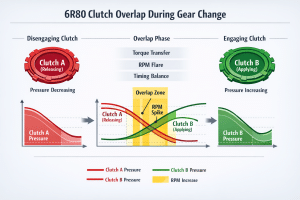
6R80 Clutch Overlap diagram
Why Harsh Shifting Often Appears Before Ratio Codes
One of the most important things to understand about the 6R80 is that harsh shifting usually appears before major transmission fault codes or mechanical failure.
The gearbox is designed to adapt around small changes in hydraulic behaviour. When the transmission detects that clutch fill times are drifting or pressure behaviour is changing, the TCM begins adjusting pressure commands to maintain smooth shifts.
For example, if a clutch begins applying slightly slower due to pressure leakage, the control system increases pressure or modifies the timing of the shift event. This works for a while and the driver may not notice anything unusual.
However, as wear continues, the adaptive strategy begins reaching its limit.
Instead of correcting the shift smoothly, the increased pressure may cause the clutch to engage too aggressively, which produces the harsh or abrupt shifts many Ranger owners notice.
This is why harsh shifting often appears before any ratio codes or slip events occur.
At this stage the transmission is still mechanically intact, but the hydraulic system is losing the precision required for smooth operation.
If the underlying cause is not addressed, the progression typically follows a predictable path:
Harsh shifting
Shift flare or hesitation
Delayed engagement into Drive or Reverse
Torque converter shudder
Ratio codes (P0731–P0735)
Clutch pack wear and rebuild
Recognising harsh shifting as an early warning sign can often prevent the transmission from progressing to more serious damage.
A detailed explanation of this failure stage can be found in our guide “Ford Ranger 6R80 Gear Ratio Codes P0731–P0735 – Clutch Pack Wear and Pressure Loss.”
How Technicians Diagnose 6R80 Harsh Shifting Properly
Proper diagnosis of harsh shifting requires more than a simple road test. Because the 6R80 is electronically controlled and highly adaptive, technicians must analyse how the transmission behaves under different operating conditions.
The diagnostic process usually begins with a full system scan. This confirms whether any transmission fault codes are present and ensures that electrical or voltage issues are not affecting gearbox behaviour.
The next step is live data analysis. Technicians monitor several important parameters while driving the vehicle, including turbine speed, output shaft speed, transmission temperature and commanded gear state.
Comparing these signals allows technicians to identify irregular clutch fill times, pressure instability or abnormal slip behaviour.
Temperature behaviour is particularly important. Many 6R80 transmissions behave normally when cold but begin shifting harshly once the fluid reaches operating temperature. This often indicates hydraulic leakage or fluid degradation, because thinner fluid reduces pressure stability.
Load testing can also be necessary. Under towing conditions or moderate acceleration, the transmission experiences higher torque loads that reveal pressure control problems more clearly.
If harsh shifting is confirmed, the valve body may require inspection and testing. Vacuum testing of hydraulic circuits allows technicians to determine whether pressure loss is occurring inside the valve body.
This systematic approach ensures the root cause of the harsh shift is identified correctly rather than guessing or replacing parts unnecessarily.
Many Rangers that begin with harsh shifting eventually develop converter shudder. You can learn more in our guide “6R80 Torque Converter Shudder – Why It Happens.”
When Harsh Shifting Becomes a Serious Transmission Problem
Not every harsh shift indicates immediate gearbox failure. However, persistent harsh shifting should never be ignored.
When the condition worsens over time, it often signals that the transmission control system is running out of adaptive correction range.
Several warning signs indicate the problem is becoming more serious:
Harsh shifts occurring more frequently
Flare between gears before engagement
Delayed engagement when selecting Drive
Shudder during light throttle cruising
Transmission temperatures rising faster than normal
Once these symptoms begin appearing together, the gearbox may be approaching the stage where clutch packs begin slipping.
At this point continued driving without diagnosis increases the risk of clutch wear, fluid contamination and more expensive repairs.
Why Many Workshops Misdiagnose Harsh Shifting
One of the biggest problems Ranger owners face is misdiagnosis of transmission behaviour.
Many workshops rely only on a short road test and may assume harsh shifting requires a fluid service or a full rebuild. Neither approach necessarily addresses the underlying cause.
Simply replacing fluid may temporarily change shift behaviour because fresh fluid has higher viscosity and better pressure stability. However, if the valve body is leaking or solenoid performance has drifted, the problem will usually return.
On the other hand, recommending a full rebuild without confirming mechanical damage can lead to unnecessary expense.
Because the 6R80 transmission relies heavily on hydraulic control precision, diagnosing the pressure behaviour of the system is far more important than guessing which component has failed.
A methodical diagnostic process helps separate early-stage hydraulic problems from genuine mechanical failure.
How Brisbane Tuning & Turbo Diagnoses 6R80 Shift Behaviour
At Brisbane Tuning & Turbo, 6R80 transmission behaviour is analysed using a structured diagnostic approach designed to identify the true cause of shift quality problems.
The process begins with a complete electronic scan to check for fault codes and system irregularities across all modules. This ensures electrical faults or voltage issues are not influencing transmission behaviour.
Next, live data from the transmission control module is monitored during road testing. Parameters such as turbine speed, output shaft speed, transmission temperature and clutch slip behaviour are analysed to detect abnormal pressure patterns.
In many cases, dyno load testing is used to replicate real-world driving conditions safely. This allows the transmission to reach operating temperature and reveals problems that may not appear during short road tests.
If hydraulic instability is suspected, the valve body can be removed and vacuum tested to confirm pressure leakage in specific circuits. This identifies whether valve body correction or further repair is required.
Using this approach allows transmission behaviour to be classified accurately and ensures the correct repair path is chosen.
What Ranger Owners Should Do if Harsh Shifting Starts
If your Ranger begins shifting harshly, the most important step is early diagnosis.
Ignoring the problem and continuing to drive normally may allow the issue to progress from a hydraulic control problem into mechanical clutch damage.
Diagnosing the problem early often allows technicians to identify pressure control issues before clutch packs begin slipping. This can prevent more serious transmission damage and reduce the likelihood of a full rebuild.
If harsh shifts are becoming more frequent, if the transmission hesitates before engaging gears, or if the gearbox behaviour changes as it warms up, it is time to have the transmission inspected.
Understanding the cause early allows the problem to be corrected before the gearbox reaches the later stages of failure.
Common Questions About 6R80 Harsh Shifting
Why does my Ford Ranger shift hard between 2nd and 3rd gear?
The 2–3 shift is one of the most sensitive events in the 6R80 transmission. Hydraulic pressure instability or valve body wear often causes the clutch to apply too aggressively during this shift.
Can low transmission fluid cause harsh shifting?
Low or degraded transmission fluid can reduce pressure stability inside the valve body, which may cause harsh gear engagement.
Will a transmission service fix harsh shifting?
A fluid service can improve shift quality temporarily if fluid condition is the cause, but hydraulic wear inside the valve body may still require repair.
A word from Brisbane Tuning & Turbo
The Ford 6R80 transmission is a sophisticated system that relies on precise hydraulic pressure control to deliver smooth gear changes. When the valve body or pressure control system begins losing accuracy, harsh shifting is often the first symptom drivers notice.
Although harsh shifting does not always mean the gearbox has already failed, it should always be taken seriously. It is often an early warning sign that the transmission control system is compensating for hydraulic instability.
By analysing transmission behaviour, pressure control patterns and temperature response, technicians can determine whether the problem originates in the valve body, solenoid control system or mechanical components.
If your Ranger is beginning to shift harshly or behave differently during gear changes, diagnosing the problem early can prevent far more serious transmission damage later.
Early diagnosis often prevents clutch damage and expensive rebuilds. A professional transmission diagnostic allows technicians to determine whether the problem is hydraulic, electronic or mechanical before serious damage occurs. If your Ranger is starting to shift harshly, a professional transmission diagnostic can determine whether the issue is hydraulic, electronic or mechanical.