Injector Problems
Injector Problems That Quietly Destroy Ford Ranger Pistons
Injector problems, one of the most dangerous engine problems a Ford Ranger can have is the one that doesn’t stop it from running. The vehicle still starts, still drives, still tows — maybe with a little more smoke, a slight roughness, or fuel economy that isn’t quite what it used to be. Nothing dramatic. Nothing urgent.
Until one day it is. Injector Problems day.
Injector-driven piston damage is one of the most misunderstood and most expensive failure paths we see in Rangers. Not because injectors fail suddenly, but because they fail quietly. And by the time the problem becomes obvious, the pistons have already paid the price.
This article explains how injector problems damage pistons, why guessing is risky and expensive, and why proper diagnostics often save engines that would otherwise fail.
Why injector problems are rarely obvious
Most people expect injector failures to be binary: working or not working. In reality, injectors almost never fail that cleanly.
They drift.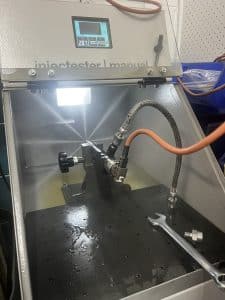
Spray patterns degrade. Flow changes slightly. Response time alters. One injector begins behaving differently from the others long before any fault code is triggered. The engine control system compensates as best it can, masking the issue under light driving.
That’s why injector problems are so often missed in their early stages. The vehicle still feels usable. No warning lights. No dramatic symptoms. Just subtle changes that are easy to ignore — especially if the Ranger is still doing its job.
What actually happens when an injector goes out of control
Diesel combustion relies on precise fuel delivery. Fuel must be injected at the correct time, in the correct quantity, and in a spray pattern that mixes evenly with air.
When an injector sticks, dribbles, overfuels, or loses spray quality, combustion stops being uniform. Instead of a controlled burn across the piston bowl, you get concentrated heat in one area.
That localised heat is what causes damage.
The piston crown begins to overheat in that hot spot. Aluminium softens. Oil cooling struggles to keep up. Rings lose their ability to seal evenly. Over time, the piston develops erosion, cracks around the ring lands, or structural failure.
The engine doesn’t fail immediately. It deteriorates.
Why pistons fail first when injectors misbehave
Injectors can misbehave for a long time. Pistons can’t.
The injector is upstream. The piston is directly exposed to the combustion event. When combustion becomes uneven, the piston absorbs the thermal punishment first.
This is why injector problems so often get mislabelled as “weak pistons.” The piston is simply the first component that can no longer tolerate the abnormal conditions created by poor fuel delivery.
The root cause is combustion control, not piston strength.
Early symptoms owners often ignore
Because injector-driven damage develops gradually, the warning signs are subtle. Many owners notice them but don’t connect them to a serious risk.
Some Rangers develop a change in exhaust smoke, often darker under load. Others feel rougher when cold or hesitate slightly when towing uphill. Fuel consumption may worsen. In some cases, the engine oil level rises or begins to smell strongly of diesel, a sign that excess fuel is entering the crankcase.
Exhaust gas temperatures can also climb higher than expected during towing, even though the engine feels otherwise normal. Occasionally, diagnostics will show one cylinder behaving differently — but without a fault code, it’s easy to dismiss.
These symptoms don’t mean the engine has failed. They mean it’s warning you.
Why guessing with injectors is so expensive
When injector problems are suspected, the most common response is guessing. Replace one injector. Replace them all. Tune around the issue. Ignore it and hope for the best.
All of those approaches are risky.
Injectors work as a set. Without knowing which injector is drifting, how badly, and under what conditions, replacing parts blindly can make the problem worse. One new injector alongside older ones can create further imbalance. Tuning around uneven fueling can increase piston stress rather than reduce it.
This is why injector guessing is one of the fastest ways to turn a manageable issue into a full engine rebuild.
What actually proves an injector problem
Injector problems must be proven with data, not assumptions.
The goal of proper injector diagnostics is to answer a simple question: is each cylinder receiving fuel evenly and predictably under real operating conditions?
That requires more than a fault code scan. Injector balance testing shows how each cylinder contributes. Return flow analysis reveals injectors that are bypassing fuel internally. Oil contamination checks identify excess fueling that isn’t being burned. Controlled load testing shows how injectors behave when the engine is actually working, not idling in a workshop.
Each of these checks reveals a different part of the picture. Together, they turn suspicion into certainty.
Why injector problems show up under load
Many injector faults are invisible at idle or light throttle. Under load, everything changes.
Injection duration increases. Cylinder pressure rises. Combustion temperatures climb. An injector that appears “fine” at idle can lose control when pushed harder.
This is why so many injector-related piston failures occur in towing vehicles. The engine spends long periods operating in the exact conditions where injector drift causes the most damage.
Static checks don’t catch that. Load testing does.
How injector diagnostics protect more than pistons
Catching injector problems early doesn’t just protect pistons. It protects the entire engine system.
Even fueling keeps exhaust temperatures under control, protects the turbocharger, maintains oil quality, and reduces stress on emissions components. Correcting injector behaviour early often prevents secondary failures that turn a small issue into a major one.
This is why injector diagnostics are about engine health, not just injectors.
Where tuning and calibration fit — without blame
Tuning rarely causes injector failures on its own. However, increased torque and load can expose injector weaknesses that already exist.
When injector health isn’t known, tuning adjustments may unintentionally increase stress on an already compromised cylinder. When injector behaviour is validated first, tuning can be used to reduce risk rather than increase it.
That’s why injector diagnostics and tuning correction work best together, not in isolation.
The Brisbane Tuning & Turbo diagnostic decision
At Brisbane Tuning & Turbo, we don’t start by selling injectors. We start by confirming injector behaviour.
Our diagnostic process is designed to determine whether injector performance is stable, drifting, or already damaging the engine. Once that’s clear, decisions become simple. Sometimes injectors need attention. Some calibration needs correction. Sometimes the engine simply needs protection before damage progresses further.
The point is clarity. Not guesswork.
Quiet problems deserve clear answers
Injector problems don’t announce themselves loudly. They quietly change the way an engine burns fuel until something expensive gives way.
If your Ford Ranger shows subtle changes in smoke, smoothness, fuel use, oil condition, or towing behaviour, that’s not something to ignore — but it’s also not something to panic about.
Getting proper injector diagnostics early often saves pistons, engines, and a lot of money. Guessing rarely does.
If you want to understand what your engine is actually doing before damage becomes permanent, that’s the conversation worth having.