Mercedes X250d Twin Turbo Failure
Mercedes X250d Twin Turbo Failure: The Real Causes, The Codes You’ll See, and How to Stop the New Turbos Dying
If your Mercedes X250d has gone into limp mode, started smoking, lost boost, or you’ve been quoted “both turbos are gone,” you’re not alone. The X250d’s twin turbo setup can fail in a way that looks like a simple parts problem, but in reality it’s often a system failure event: once one turbo starts to break down, it can contaminate the intake and control system, stress the other turbo, and make the next replacement fail again if the underlying cause isn’t found.
Mercedes X250d Twin Turbo Failure explained
This guide is written to be useful, not vague. It explains why the X250d twin turbos often fail together, the exact boost and turbo-related fault codes you’ll commonly see on scan tools, and the correct diagnostic and repair approach so you don’t end up paying for turbos twice.
The most common symptoms of X250d turbo failure
Most owners don’t get a clean “turbo is dead” moment. They get a pattern. The vehicle feels fine in gentle driving, then falls over under load. It might only happen when towing, climbing hills, merging, or accelerating hard. You’ll often see one or more of these:
Loss of power and limp mode under load, 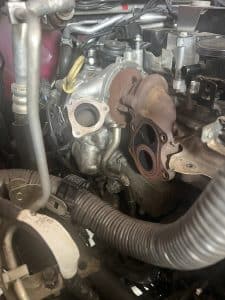
Delayed boost or “flat” acceleration,
Loud whistle/siren noise,
Oil consumption, smoke (often blue/grey from oil), and sometimes repeated hose popping, boost leaks, or an oily mess inside the intercooler piping. The engine may log faults and limit boost to protect itself.
The important point is this: these symptoms can be caused by a failed turbo, but they can also be caused by control issues or charge-air leaks that look like turbo failure. That’s why the fault-code section later in this article matters.
Why both turbos can fail together on a twin turbo setup
On many twin-turbo systems, one unit does most of the low-speed work and the second supports higher load and airflow. When the control system, oil supply, or charge-air system starts to misbehave, it can push one turbo outside its safe operating zone, and the second turbo ends up paying the price shortly after.
Here are the real-world failure chains we see most often on twin-turbo utes:
1) Underboost from a leak leads to overspeed and turbo damage
A split hose, intercooler leak, loose clamp, or cracked charge pipe causes the engine to request boost that never arrives. The ECU keeps commanding more turbo to hit target, and the turbo can overspeed trying to make pressure that’s being lost through the leak. Over time, overspeed and heat take out bearings, seals, or compressor wheels. On scan tools this often shows as an underboost code like P0299.
2) Overboost or sticking control causes repeated limp events and heat stress
If vane control (VNT) or boost control sticks, or the actuator feedback is wrong, the system can overboost. The ECU often reacts by dumping boost, cutting torque, and cycling control hard. That spike-and-correct pattern is rough on a turbo system. A common generic overboost code is P0234.
3) Boost control actuator or position feedback faults create “ghost turbo failures”
A turbo can be mechanically healthy but functionally useless if the actuator can’t move correctly or the ECU can’t trust its position signal. Faults like P2562 or P2563 are typical “boost control position sensor/actuator position” style problems that often present as limp mode and unstable boost.
4) Solenoid or wiring faults make boost control unpredictable
A boost control solenoid fault can make the system behave like it has a failing turbo: underboost one moment, overboost the next, limp mode under load, and terrible drivability. P0243 is a common generic code family linked to wastegate/boost control solenoid electrical issues.
5) One turbo fails mechanically and contaminates the whole system
This is the big one. Once a turbo sheds metal, oil, or bearing material, it doesn’t just “stay in the turbo.” Oil can travel through the charge-air system into the intercooler and pipes. Metal can move through the intake tract. If the intercooler and piping aren’t treated as contaminated, the replacement turbo can ingest debris or run with oil-contaminated airflow, and the second turbo failure can follow.
This is why replacing “just the bad turbo” without a system-level clean/inspect/validate is one of the most expensive mistakes you can make on a twin-turbo diesel.
Turbo and boost fault codes to include in your diagnosis
This section is designed as a lookup. Scan tools vary, but the code families below are the ones that most commonly show up around turbo/boost faults on the X250d and similar Mercedes diesel systems.
P0299 – Turbocharger/Supercharger “A” Underboost
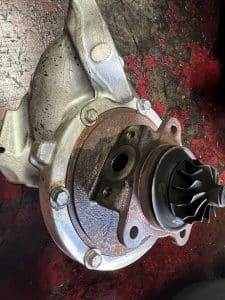
X250d Twin Turbo Failure taken out of the vehicle
What it usually means: the ECU measured boost lower than requested. This is one of the most common turbo-related codes on modern diesels, and it does not automatically mean “turbo is dead.”
What commonly causes it: charge-air leaks (hose/intercooler), sticking actuator or control problems, boost solenoid issues, intake restrictions, exhaust restrictions, sensor issues, or genuine turbo efficiency failure.
We test first: smoke test of the charge-air system, clamp/pipe integrity, intercooler leaks, live-data comparison of requested vs actual boost under load, actuator command and movement tests, and sensor plausibility.
P0234 – Turbocharger/Supercharger Overboost Condition
What it usually means: boost exceeded the expected limit or the system couldn’t control boost down.
What commonly causes it: VNT vane sticking, actuator control faults, boost solenoid/wiring faults, incorrectly routed vacuum/pressure lines (depending on control type), sensor plausibility, or mechanical turbo issues.
We test first: boost control response under commanded tests, actuator position feedback, vane/actuator travel (where accessible), and verification that the control system can both increase and decrease boost cleanly.
P2562 / P2563 – Boost Control Position Sensor / Actuator Position Faults
What it usually means: the ECU has detected a problem with the turbo actuator position signal or the actuator’s ability to reach/track commanded positions. These are extremely relevant because they can mimic turbo failure symptoms perfectly.
What commonly causes it: actuator failure, wiring/connectors, corrosion, stuck mechanism, incorrect calibration/adaptation, or feedback signal out of range.
We test first: actuator command tests, position feedback tracking, harness inspections at the actuator plug, and checking for consistent movement across the operating range.
P0243 – Wastegate/Boost Control Solenoid “A” (Electrical)
What it usually means: the ECU has detected an electrical fault in the boost control solenoid circuit (open/short/incorrect response).
What commonly causes it: solenoid failure, wiring faults, connector issues, and sometimes incorrect solenoid type if a prior repair used the wrong component.
We test first: circuit testing, commanded operation, verifying the solenoid actually changes control pressure/vacuum, and confirming the rest of the boost control system is behaving.
Mercedes-specific “charge pressure control” fault families commonly seen as 2359 / 2632 / 2510 variants
Many Mercedes-focused scan tools and forum discussions refer to charge pressure control faults using codes like 2359 with subcodes (for example, “charge pressure too low” vs “too high”), as well as related faults that point toward charge pressure regulation and control plausibility. These show up in the same universe as underboost/overboost and are often the “Mercedes language” version of what generic OBD calls P0299/P0234.
What these usually mean in plain English: the ECU isn’t happy with the relationship between requested boost, measured boost, and control position. That points you back to the same three pillars every time: charge-air integrity, boost control hardware (actuator/solenoid/wiring), and turbo efficiency/condition.
We test first: we don’t guess. We verify boost target vs actual under load, verify actuator control and feedback, and prove the intake/charge-air system is sealed.
Supporting sensor codes that often appear with turbo faults
On many vehicles, turbo problems drag sensor plausibility issues along for the ride. Oil in the intake can contaminate sensors, leaks can create mismatched airflow, and control faults can cause boost readings that don’t align with expected airflow. You may see MAP/MAF plausibility-style faults alongside charge pressure control faults, and it’s important to understand they can be either the cause or the result, depending on what testing shows.
The key is to avoid “parts darts.” We validate the system and identify what’s actually failing.
How do we diagnose an X250d twin turbo problem properly
A correct diagnosis is not “read code, fit turbo.” Codes tell you where to look, not what to replace. A proper turbo diagnosis has to answer four questions:
Is the charge-air system sealed? Can the ECU control boost accurately? Are the sensors telling the truth? Is the turbo mechanically healthy?
In practice, that looks like this.
First, we verify charge-air integrity with a proper pressure/smoke test. Many underboost cases are leaks, and leaks are the #1 way to overspeed and kill a turbo. If the system can’t hold pressure, the turbo gets blamed for a problem it didn’t create, and the replacement turbo gets forced into the same overspeed situation.
Second, we verify boost control operation. That means actuator command testing and checking that position feedback tracks the command. If there’s an actuator or position fault (think P2562/P2563), you can chase turbos forever and never fix the root issue.
Third, we verify sensor plausibility using live data. Requested boost vs actual boost under load is the truth-teller. A car can idle perfectly and still fail under load. We want to see what happens when the vehicle is doing the thing that triggers limp mode.
Fourth, we assess mechanical condition and contamination risk. If one turbo has failed mechanically, we treat the intake tract and intercooler as contaminated until proven otherwise, because that contamination is how “brand new turbos” die.
The correct repair path after a turbo failure
If a turbo has genuinely failed, the repair is not just the turbo. The correct repair is “turbo + cause + contamination control.”
That includes confirming oil supply and oil return health (restrictions and poor drainage kill turbos), confirming the charge-air system is sealed and not forcing overspeed, confirming boost control hardware and wiring are correct, and dealing with contamination in the intercooler and intake tract. If oil and debris remain in the system, you are effectively feeding risk into the next turbo.
If both turbos have failed, the system-level approach matters even more. Twin turbo systems don’t forgive shortcuts because they share airflow pathways and control logic. Fixing one side without correcting the system is how repeat failures happen.
How to prevent repeat failure on the X250d
If you want the new turbos to live, focus on what actually kills turbos: overspeed from leaks, heat stress from uncontrolled boost events, oil supply/return problems, and contamination after a failure.
That means you don’t accept “it has an underboost code, it needs a turbo” as a diagnosis. Underboost can be leaks, control faults, actuator faults, or a turbo — and the correct order is to prove the system first. P0299 is common, but it’s not a turbo sentence on its own.
It also means you don’t ignore actuator and control codes. If you have actuator position faults like P2562/P2563, you treat those as primary suspects.
And if you’ve had an overboost event like P0234, you take it seriously, because overboost spikes can drive heat and stress that shorten turbo life dramatically.
When it might not be the turbo at all
It’s surprisingly common for customers to be told “turbos are gone” when the actual failure is:
a boost leak,
actuator control fault,
or solenoid/wiring issue. A vehicle can feel gutless and throw turbo codes while the turbo itself is mechanically sound.
That’s why the best money you can spend is not on guessing parts. It’s better to have a proper turbo system diagnosis that proves the fault under load and validates the control system.
If your Mercedes X250d is in limp mode, smoking, losing boost, or showing boost/turbo codes, our approach is simple: we validate the system properly before recommending expensive hardware. We test charge-air integrity, verify boost control and actuator behavior, confirm sensor plausibility with live data, and if there’s been a mechanical turbo failure, we treat contamination as a real risk so the replacement doesn’t die again.
If you want this handled as a system — not a guess — book in for a turbo and boost control diagnosis with Brisbane Tuning & Turbo.