Nissan CVT Transmission Problems
Nissan CVT Transmission Problems, Symptoms, Diagnosis & Repair
Nissan CVT transmissions have developed a mixed reputation over the years. Some owners drive well beyond 250,000 km without major problems, while others face expensive repairs much sooner.
At Brisbane Tuning & Turbo, we’ve found that most CVT failures don’t happen suddenly. In many cases the transmission gives warning signs first, such as a shudder under acceleration, delayed engagement, higher engine RPM or an occasional fault code. The earlier these problems are diagnosed, the greater the chance of avoiding major internal damage.
One of the biggest mistakes we see is replacing parts based purely on a fault code. A scan tool tells us which system needs investigating, not which component has failed. Proper diagnosis means understanding how the transmission works before deciding what needs repairing.
Which Nissan Vehicles Use Jatco CVT Transmissions?
Nissan has used several generations of Jatco CVT transmissions, and although they all work in a similar way, they don’t all fail for the same reasons.
The most common CVTs found in Australian Nissan vehicles include:
| Transmission | Common Applications |
|---|---|
| JF011E | Dualis, X-Trail T31, Altima |
| JF015E | Juke, Pulsar, Qashqai |
| JF016E | X-Trail T32, Qashqai, Serena |
| JF017E | Pathfinder, Murano, some X-Trail models |
Knowing which transmission is fitted to your vehicle is the first step in accurate diagnosis. A 2011 X-Trail and a 2021 X-Trail may both have CVTs, but their valve bodies, software, common faults and repair procedures are quite different.
How the vehicle is used is just as important. A Pathfinder that regularly tows a caravan places far more stress on its transmission than a Qashqai used mainly for commuting. That’s why we always identify the exact transmission before recommending any repairs.
How a Nissan Jatco CVT Works
A conventional automatic transmission changes between fixed gears. A CVT doesn’t. Instead, it continuously changes its drive ratio to keep the engine operating efficiently.
Power flows through the transmission like this:
Engine → Torque Converter → Primary Pulley → Steel Belt → Secondary Pulley → Final Drive → Wheels
The two pulleys change size hydraulically. As one pulley becomes larger, the other becomes smaller, allowing the transmission ratio to change smoothly instead of shifting between gears.
The key to making this work is hydraulic pressure.
The hydraulic pump supplies oil to the valve body, which controls the pulleys and clamps the steel belt between them. If there isn’t enough pressure, the belt can’t grip the pulleys properly. When that happens, the transmission can begin to shudder, slip, overheat or set pressure-related fault codes.
This is why so many Nissan CVT problems eventually trace back to the hydraulic system. A worn valve body, sticking solenoid, contaminated fluid or weak pump can all reduce hydraulic pressure and affect the way the transmission operates.
Why Nissan CVT Transmissions Fail
Most Nissan CVT failures don’t begin with a major mechanical failure. They usually start with a small problem that becomes worse over time.
The most common causes we see are:
- Valve body wear
- Pressure control solenoid problems
- Hydraulic pressure loss
- Overheated or contaminated CVT fluid
- Steel belt and pulley wear after prolonged slipping
These faults are often connected rather than occurring individually. For example, a worn valve body can reduce hydraulic pressure. Reduced hydraulic pressure allows the steel belt to slip. Belt slip generates heat, and excessive heat accelerates wear throughout the transmission & noise.
This is why early diagnosis is so important. A transmission that only needs a valve body repair today may require a complete rebuild if the underlying problem is ignored for another 20,000 kilometres. If the CVT installed on your Nissan starts to act funny, make noise or does not have as much power as it used to – bring it in for diagnostics.
The good news is that many Nissan CVT problems give warning signs before major damage occurs. Recognising those symptoms early can significantly reduce repair costs.
Why Do Nissan CVTs Have a Poor Reputation?
If you’ve spent any time researching Nissan CVTs online, you’ve probably come across conflicting opinions. Some owners report driving well over 250,000 kilometres without major issues, while others describe expensive failures at much lower mileage. So why do these transmissions have such a mixed reputation?
The answer isn’t as simple as saying Nissan CVTs are “good” or “bad.” Like any mechanical system, their reliability depends on several factors, including maintenance, operating conditions and how quickly developing problems are diagnosed.
One of the biggest contributors to the CVT’s reputation is that many early warning signs are easy to overlook. A slight shudder, occasional hesitation or small increase in engine RPM may not seem serious, so the vehicle continues to be driven. Unfortunately, these symptoms often indicate that hydraulic pressure is no longer being controlled correctly. As the transmission continues to operate, the steel belt, pulleys and bearings are subjected to increasing stress, allowing a relatively minor hydraulic fault to develop into major internal damage.
CVT maintenance
Another factor is maintenance. CVT fluid does far more than lubricate moving parts. It also transfers hydraulic pressure, controls friction and helps remove heat from the transmission. As the fluid ages, these properties gradually deteriorate. If the fluid isn’t replaced at appropriate intervals, hydraulic performance can decline, accelerating wear inside the valve body and other internal components.
Vehicle use also plays an important role. A Qashqai driven mainly around the city places very different demands on its transmission than a Pathfinder regularly towing a caravan or a heavily loaded X-Trail travelling long distances in hot Australian conditions. Higher loads generate more heat and require greater hydraulic pressure to transmit engine torque, increasing the demands placed on the transmission.
In our experience, many Nissan CVTs aren’t destroyed by one sudden catastrophic failure. They deteriorate gradually. A small hydraulic problem becomes a larger hydraulic problem. Eventually, that hydraulic problem becomes mechanical wear. By the time the vehicle loses drive or stores a severe fault code, the damage has often been developing for thousands of kilometres.
The good news is that every Nissan CVT can be rebuilt. The key is recognising the warning signs early and diagnosing the cause before unnecessary internal damage occurs.
Why Heat Is One of the Biggest Enemies of a Nissan CVT
Heat is one of the biggest factors affecting the life of a Nissan CVT. While most owners think of transmission fluid simply as a lubricant, it actually performs several critical jobs inside the transmission.
CVT fluid lubricates bearings and moving components, transfers hydraulic pressure throughout the valve body, controls the friction characteristics needed for the steel belt and pulleys to operate correctly, and carries heat away from internal components.
As the transmission temperature rises, the fluid gradually loses some of its ability to perform these jobs effectively. Hydraulic pressure becomes more difficult to control, the valve body has to work harder to regulate pressure, and the steel belt may no longer be clamped with the force required to transmit engine torque efficiently. Over time, this increases wear throughout the transmission.
Heat accelerates ageing in CVT
Heat also accelerates the ageing of the fluid itself. As the fluid deteriorates, it becomes less effective at protecting internal components and controlling hydraulic pressure. This is one of the reasons why old or contaminated CVT fluid should never be ignored.
Australian driving conditions can make this even more important. Long highway trips, towing caravans or trailers, climbing steep hills, driving in heavy traffic and operating in high ambient temperatures all increase the amount of heat generated inside the transmission. While Nissan engineers designed these transmissions to operate under a wide range of conditions, prolonged exposure to excessive heat can shorten the life of any automatic transmission if developing problems are left unaddressed.
Fortunately, heat-related failures rarely occur without warning. Drivers often notice shuddering, delayed engagement, rising engine RPM, reduced performance or transmission warning lights before significant internal damage occurs. Recognising these symptoms early and investigating the cause gives you the best opportunity to prevent more extensive and expensive repairs.
One of the simplest ways to extend the life of a Nissan CVT is to maintain clean, high-quality transmission fluid and investigate changes in transmission behaviour as soon as they appear. Heat on its own doesn’t usually destroy a CVT. Heat combined with worn fluid, hydraulic pressure loss or an existing fault is what accelerates internal wear.
Common Nissan CVT Problems Symptoms
A Nissan CVT rarely fails without warning. In most cases, the transmission develops one or more symptoms before a fault code appears or the vehicle stops driving altogether.
One of the most common complaints is shuddering during acceleration. This may feel like driving over rumble strips or a vibration as the vehicle pulls away or accelerates up a hill. Possible causes include hydraulic pressure loss, valve body wear or excessive wear of the steel belt and pulleys.
Another common symptom is engine RPM increasing without a matching increase in vehicle speed. Drivers often describe this as the engine revving harder while the vehicle feels slow to accelerate. This can indicate belt slip, low hydraulic pressure or internal transmission wear.
Some owners notice a delay when selecting Drive or Reverse. Instead of engaging immediately, the transmission hesitates for a second or two before the vehicle begins to move. This may indicate internal pressure loss or valve body problems.
As the condition worsens, the transmission may begin to jerk, surge or enter fail-safe mode, limiting vehicle performance to protect itself from further damage. The check engine light or transmission warning light may also illuminate, often accompanied by fault codes stored in the Transmission Control Module.
Other common symptoms include:
- Shudder during acceleration
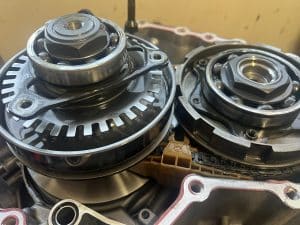
CVT Nissan disassembly
- Delayed engagement into Drive or Reverse
- Poor acceleration with high engine RPM
- Transmission overheating
- Whining or humming noises
- Warning lights or fault codes
- Vehicle stuck in fail-safe mode
While these symptoms provide valuable clues, they do not identify the failed component. The same symptom can be caused by several different faults, which is why professional diagnosis is essential before replacing parts or the complete transmission.
Should You Continue Driving With a Nissan CVT Fault?
One of the most common questions we’re asked is whether it’s safe to continue driving with a Nissan CVT that’s showing signs of a problem.
The answer depends on the symptoms, but one thing is almost always true: continuing to drive a transmission that is already slipping or losing hydraulic pressure will usually increase the cost of the eventual repair.
If you notice a slight shudder during acceleration, an occasional delay selecting Drive or Reverse, or a transmission warning light with no obvious change in vehicle performance, the vehicle may still be safe to drive carefully while you arrange a professional diagnosis. However, these symptoms should never be ignored, as they often indicate the early stages of a developing fault.
If the shudder becomes more noticeable, engine RPM rises without corresponding vehicle acceleration, the transmission begins overheating, or the vehicle repeatedly enters fail-safe mode, the problem should be investigated as soon as possible. Continuing to drive under these conditions can allow additional wear to occur inside the transmission.
If the transmission is making loud mechanical noises, has lost drive, slips severely under light acceleration, or will no longer engage Drive or Reverse correctly, we recommend stopping driving the vehicle and arranging for it to be inspected.
Continuing to operate the transmission after major internal damage has occurred can circulate metal particles throughout the hydraulic system, damaging components that may otherwise have been reusable.
The financial difference can be significant. A transmission diagnosed during the early stages of a hydraulic or valve body problem may only require limited repairs. The same transmission, if driven for weeks or months after the first warning signs appear, may eventually require replacement of the steel belt, pulleys, bearings and other internal components during a complete rebuild.
If you’re unsure whether your Nissan is safe to drive, it’s always better to ask than to guess. A professional transmission diagnostic is usually far less expensive than repairing the additional damage that can result from continuing to drive with an undiagnosed fault.
Our advice is simple: don’t wait for your Nissan CVT to stop driving before having it checked. Most transmissions tell you something is wrong long before they fail completely. Listening to those warning signs is often the difference between a smaller repair and a much larger one.
Signs Your Nissan CVT May Need Immediate Attention
Not every transmission symptom is an emergency, but some warning signs indicate that continuing to drive could result in significant internal damage. If you notice any of the following symptoms, we recommend arranging a professional transmission inspection as soon as possible.
Flashing Transmission or Check Engine Light
A warning light that flashes rather than remaining constantly illuminated often indicates that the Transmission Control Module has detected a fault severe enough to affect normal operation. Continuing to drive without diagnosis may allow further damage to occur.
Severe Shudder or Vibration During Acceleration
A slight shudder may indicate the early stages of a hydraulic problem, but a severe or rapidly worsening shudder can suggest excessive belt slip or significant internal wear. Driving under these conditions increases the risk of damaging the steel belt and pulleys.
Burning Smell
A burnt smell coming from the transmission area often indicates excessive heat or overheated CVT fluid. High temperatures reduce the fluid’s ability to provide hydraulic pressure and lubrication, accelerating internal wear.
Metallic Noise
Grinding, rattling, whining or other unusual metallic noises should never be considered normal. These sounds may indicate bearing failure, internal mechanical damage or components that are no longer operating correctly.
Transmission Will Not Engage Drive or Reverse
If there is a significant delay selecting Drive or Reverse, or the transmission fails to engage altogether, the vehicle should not continue to be driven until the cause has been identified. Low hydraulic pressure or internal mechanical failure may be preventing it from being engaged.
Common Nissan CVT Fault Codes
Modern Nissan CVTs are monitored continuously by the Transmission Control Module (TCM). When the TCM detects that a sensor reading or hydraulic value is outside its expected range, it stores a Diagnostic Trouble Code (DTC).
One of the biggest misconceptions is that a fault code identifies the failed component. In reality, a fault code tells us which system requires further testing, not which part should be replaced.
Some of the more common Nissan CVT fault codes include:
| Fault Code | Description | Common Causes |
|---|---|---|
| P0746 | Pressure Control Solenoid Performance | Valve body wear, sticking solenoid, hydraulic pressure problems |
| P0776 | Pressure Control Solenoid B Performance | Solenoid fault, valve body wear |
| P0841 | Transmission Fluid Pressure Sensor Range/Performance | Pressure sensor fault, hydraulic pressure issue |
| P0868 | Secondary Pressure Too Low | Low hydraulic pressure, worn pump, valve body wear |
| P0965 / P0967 | Pressure Control Solenoid Circuit | Electrical or solenoid faults |
| P2813 | Pressure Control Solenoid G | Valve body or solenoid problem |
| P17F0 / P17F1 | CVT Judder Detected | Internal transmission wear, belt or pulley wear, excessive slip |
While these codes are useful, they should never be used on their own to decide whether a transmission needs a valve body repair, a rebuild or replacement.
For example, P0868 (Low Hydraulic Pressure) may be caused by a worn valve body, a sticking pressure control solenoid, internal leakage or a worn hydraulic pump. Replacing the first component mentioned in the fault description without further testing can become an expensive guess.
Similarly, P17F1 (CVT Judder) does not automatically mean the transmission requires replacement. The code simply tells us that the TCM has detected excessive slip or vibration. The next step is determining why the judder is occurring.
At Brisbane Tuning & Turbo, we use fault codes as the starting point of the diagnostic process—not the final diagnosis. We combine scan data with road testing, live data analysis and transmission inspection before recommending any repairs.
How We Diagnose Nissan CVT Problems
Diagnosing a Nissan CVT should never start with replacing parts. It should start with understanding why the transmission is behaving the way it is.
Our diagnostic process typically includes:
- Discussing the symptoms with the owner.
- Road testing the vehicle.
- Scanning the Transmission Control Module for fault codes.
- Analysing live data while driving.
- Checking the condition and level of the CVT fluid.
- Assessing whether the fault is likely hydraulic, electrical or mechanical.
During the road test we’re looking for more than just fault codes. We want to know when the problem occurs.
Does it shudder only under acceleration?
Or does it occur when the transmission is cold?
Does it happen after the transmission reaches operating temperature?
Does towing make the problem worse?
The answers to these questions often tell us more than the fault code itself.
Live data is equally important. We compare requested and actual pulley ratios, transmission temperature, pressure-related data and sensor information to determine whether the transmission is operating as designed.
Only after gathering this information do we recommend a repair. In some cases a valve body repair is all that’s required. In others, the transmission has suffered internal mechanical damage and a rebuild becomes the most reliable solution.
Our philosophy is simple: diagnose first, repair second. It helps avoid unnecessary parts replacement and gives our customers a clear understanding of what has actually failed and why.
Nissan CVT Repair Options
Not every Nissan CVT with a fault code needs a complete rebuild. The correct repair depends on what has actually failed.
If the problem is caused by contaminated fluid or poor maintenance, a CVT fluid service may improve transmission operation. However, it’s important to understand that changing the fluid will not repair worn mechanical or hydraulic components.
If testing identifies excessive wear in the valve body or faulty pressure control solenoids, a valve body repair or replacement may be the most cost-effective solution. Catching these problems early can often prevent more extensive internal damage.
Once the steel belt, pulleys or bearings have been damaged, the transmission will usually require a complete rebuild or replacement. At this stage, simply replacing the valve body will not correct the underlying mechanical wear.
Some owners consider fitting a second-hand transmission. This can be a suitable option in some cases, but it’s important to remember that the replacement unit has an unknown history. Its condition depends entirely on how it was maintained and used before installation.
The most important step is choosing the right repair for the fault—not the cheapest repair or the most expensive one.
At Brisbane Tuning & Turbo, we explain what has failed, why it has failed and the repair options available, allowing you to make an informed decision before any major work begins.
Repair, Rebuild or Replace?
One of the biggest misconceptions about Nissan CVT transmissions is that every fault requires a complete replacement transmission. In reality, the most appropriate repair depends on what has actually failed.
If diagnosis shows that the problem is limited to the valve body or pressure control solenoids, a valve body repair or replacement may be all that’s required. Addressing hydraulic problems early can restore correct transmission operation before significant internal wear occurs. This is often the most cost-effective repair because the major internal components have not yet been damaged.
If internal inspection reveals wear of the steel belt, pulleys, bearings or other mechanical components, a complete rebuild is usually the best long-term solution. During a rebuild, worn parts are replaced, internal clearances are restored and the transmission is returned to a reliable operating condition. Rebuilding your own transmission also means you keep a unit with a known service history rather than replacing it with one of unknown condition.
Is a second-hand transmission a good option?
A second-hand transmission can sometimes be an appropriate option, particularly if your existing transmission has suffered catastrophic damage and a quality replacement unit is available. However, every used transmission has an unknown history. It may have been well maintained, or it may already have significant internal wear that is not immediately apparent. While a second-hand unit can reduce the initial repair cost, it also carries a higher level of uncertainty.
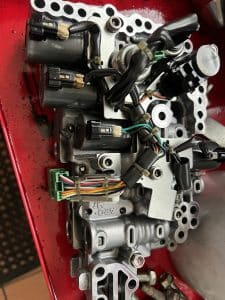
Valve Body CVT Nissan
Complete transmission replacement is generally reserved for situations where repairing the original transmission is no longer economically practical or where a suitable replacement provides the best outcome for the customer. Even then, we recommend understanding why the original transmission failed before installing another one. If the root cause isn’t identified, the same problem may eventually affect the replacement transmission.
There is no single repair that is right for every Nissan CVT. The best solution depends on the condition of the transmission, the extent of the damage, your long-term plans for the vehicle and your budget. A professional diagnosis allows these options to be discussed with confidence rather than relying on assumptions.
At Brisbane Tuning & Turbo, our goal is to recommend the repair that makes the most technical and financial sense—not simply the largest repair. We believe every customer should understand what has failed, why it failed and the advantages and disadvantages of each repair option before making a decision.
Can Nissan CVT Problems Be Prevented?
Not every Nissan CVT failure can be prevented, but many can be detected before they become major repairs.
The most important maintenance item is using the correct Nissan-approved CVT fluid and servicing the transmission at appropriate intervals. Old or contaminated fluid can affect hydraulic performance and increase wear inside the valve body.
If you regularly tow a caravan, trailer or boat, remember that heat is one of the biggest enemies of any CVT. Avoid prolonged heavy acceleration where possible and investigate any overheating warnings or changes in transmission behaviour as soon as they appear.
Just as importantly, don’t ignore early warning signs. A slight shudder, delayed engagement, occasional flare in engine RPM or a newly stored fault code may seem minor, but they are often the first indication that something is changing inside the transmission.
The earlier a problem is diagnosed, the more repair options are usually available. Waiting until the vehicle no longer drives often turns a relatively straightforward repair into a much more expensive rebuild or replacement.
Regular servicing won’t guarantee that a CVT will never fail, but good maintenance and early diagnosis give it the best chance of a long and reliable service life. At Brisbane Tuning & Turbo we recommend CVT service every 40,000km and even 30,000KM if you tow.
Why Choose Brisbane Tuning & Turbo?
A transmission fault doesn’t automatically mean you need a replacement transmission. In many cases, the real challenge is identifying what has actually failed.
At Brisbane Tuning & Turbo, we specialise in diagnosing automatic transmission and CVT faults before recommending repairs. Whether the problem is hydraulic, electrical or mechanical, our goal is to identify the root cause rather than replace parts unnecessarily.
Our workshop repairs and rebuilds automatic transmissions every day, giving us practical experience with common Nissan CVT problems, valve body failures, hydraulic pressure faults and transmission diagnostics.
If your Nissan CVT is shuddering, slipping, displaying fault codes or simply doesn’t feel right, we recommend having it professionally assessed before the damage becomes more extensive.
At Brisbane Tuning & Turbo, we don’t replace transmissions based on assumptions. We diagnose the cause first, explain our findings, and then recommend the most appropriate repair.
Frequently Asked Questions About Nissan CVT Transmissions
How long should a Nissan CVT last?
There isn’t a fixed lifespan. We’ve seen Nissan CVTs exceed 250,000 km, while others develop problems much earlier. Driving conditions, servicing and how quickly faults are diagnosed all play a major role.
Should CVT fluid be changed?
Yes. CVT fluid is both a lubricant and the hydraulic fluid that operates the transmission. As it ages, its performance deteriorates, which can contribute to hydraulic and valve body problems.
Can a CVT be repaired, or does it always need replacing?
Many Nissan CVT problems can be repaired. Depending on the fault, the solution may involve servicing, valve body repairs, solenoid replacement or a complete rebuild. Accurate diagnosis determines the most appropriate repair.
Can I keep driving if my CVT is shuddering?
A slight shudder may seem minor, but it often indicates that something is no longer operating correctly. Continuing to drive may allow additional internal damage to occur, increasing the cost of repairs.
Is a fault code enough to diagnose the transmission?
No. Fault codes are an important starting point, but they don’t identify the failed component. Professional diagnosis combines fault codes with road testing, live data and transmission inspection.
Is a second-hand CVT a good option?
It can be, but the condition of any used transmission depends on its history. A second-hand unit may be a cost-effective solution, but it also carries the risk of unknown wear or hidden faults.
Do you repair Nissan CVT transmissions?
Yes. We diagnose, repair and rebuild Nissan CVT transmissions, including valve body faults, hydraulic pressure problems and internal transmission failures. If you’re unsure what’s causing the problem, we recommend starting with a professional transmission diagnostic.
I like this section because it starts building your Nissan content cluster without looking like it’s written for SEO.
Nissan CVT Problems by Vehicle Model
Although Nissan uses the same basic CVT design across many models, not every vehicle develops the same problems. Vehicle weight, engine torque and driving conditions all influence how the transmission performs and how it wears over time.
Nissan X-Trail CVT Problems
The X-Trail is one of the most common Nissan models we see with CVT concerns. Owners commonly report shuddering under acceleration, delayed engagement, overheating and pressure-related fault codes, particularly on vehicles used for towing or long-distance driving.
Nissan Qashqai CVT Problems
The Qashqai generally places less load on its transmission than larger Nissan models, but valve body wear, pressure control solenoid faults and shuddering are still common as mileage increases.
Nissan Pathfinder CVT Problems
The Pathfinder is a heavier vehicle, and many are used for towing caravans, trailers and boats. This places greater demand on the transmission and can accelerate wear if overheating or hydraulic pressure problems develop.
Nissan Murano CVT Problems
Murano models equipped with the V6 engine produce more torque than smaller Nissan vehicles, making early diagnosis particularly important if shuddering, slipping or delayed engagement is noticed.
Nissan Juke CVT Problems
Most Juke models spend their lives in urban traffic, where frequent stop-start driving places constant demand on the transmission. Owners commonly report hesitation, shuddering and occasional transmission warning lights.
Nissan Pulsar CVT Problems
The Pulsar is generally a lighter application, but it can still develop valve body faults, pressure-related problems and delayed engagement as the transmission ages.
We have dedicated diagnostic guides for each of these Nissan models, covering their most common transmission problems, fault codes and repair options in greater detail.
Common Nissan CVT Fault Codes Explained
If your scan tool has reported one of the following fault codes, it doesn’t necessarily mean a specific component has failed. In most cases, the Transmission Control Module (TCM) has detected an abnormal operating condition and stored a fault code to help narrow the diagnostic process.
The following are some of the most common Nissan CVT fault codes we encounter. Each one deserves a proper diagnosis before any parts are replaced. We’ve also written dedicated guides explaining each code in greater detail.
P17F0 – CVT Judder Detected
P17F0 indicates that the TCM has detected excessive transmission judder during operation. This usually points to internal wear within the CVT rather than an electrical fault.
Possible causes include:
- Steel belt and pulley wear
- Internal clutch damage
- Hydraulic pressure loss
- Advanced transmission wear
Read our dedicated guide: Nissan P17F0 CVT Judder Detected – Causes, Diagnosis & Repair.
P17F1 – CVT Judder (Severe Deterioration)
P17F1 is similar to P17F0 but generally indicates that the transmission deterioration has progressed further. In many cases, the TCM has detected repeated judder events that exceed Nissan’s allowable limits.
Possible causes include:
- Severe belt or pulley wear
- Internal transmission damage
- Hydraulic pressure problems
- Mechanical failure requiring transmission repair or replacement
Read our dedicated guide: Nissan P17F1 CVT Judder – Causes, Diagnosis & Repair.
P0746 – Pressure Control Solenoid Performance
This code indicates that the transmission cannot correctly regulate hydraulic line pressure. The fault may involve the pressure control solenoid itself, the valve body or a hydraulic problem preventing normal pressure control.
Possible causes include:
- Pressure control solenoid failure
- Valve body wear
- Contaminated CVT fluid
- Hydraulic leakage
- Internal pump wear
Read our dedicated guide: Nissan P0746 Pressure Control Solenoid Performance – Causes, Diagnosis & Repair.
P0776 – Pressure Control Solenoid “B” Performance
P0776 indicates that Pressure Control Solenoid “B” is not operating within its expected range. While the solenoid may be faulty, valve body wear or hydraulic problems can produce the same fault code.
Possible causes include:
- Faulty pressure control solenoid
- Worn valve body
- Hydraulic pressure loss
- Internal transmission wear
Read our dedicated guide: Nissan P0776 Pressure Control Solenoid “B” – Causes, Diagnosis & Repair.
P0841 – Transmission Fluid Pressure Sensor Range/Performance
This code indicates that the TCM is receiving an unexpected signal from the transmission fluid pressure sensor. The problem may be electrical, hydraulic or mechanical.
Possible causes include:
- Pressure sensor failure
- Wiring or connector faults
- Valve body problems
- Hydraulic pressure abnormalities
Read our dedicated guide: Nissan P0841 Transmission Fluid Pressure Sensor – Causes, Diagnosis & Repair.
P0868 – Transmission Fluid Pressure Low
P0868 is one of the more important CVT fault codes because it indicates that hydraulic pressure has fallen below the level required for normal transmission operation. Continuing to drive with low hydraulic pressure can result in rapid internal damage.
Possible causes include:
- Low CVT fluid level
- Internal hydraulic leakage
- Valve body failure
- Oil pump wear
- Internal transmission damage
Read our dedicated guide: Nissan P0868 Low Transmission Fluid Pressure – Causes, Diagnosis & Repair.
P2813 – Pressure Control Solenoid “G”
P2813 indicates that the TCM has detected an electrical or performance problem involving Pressure Control Solenoid “G”. Depending on the transmission model, the fault may originate from the solenoid, valve body, wiring or the TCM’s inability to achieve the commanded hydraulic pressure.
Possible causes include:
- Pressure control solenoid failure
- Valve body wear
- Wiring or connector problems
- Hydraulic pressure faults
- Internal transmission damage
Read our dedicated guide: Nissan P2813 Pressure Control Solenoid “G” – Causes, Diagnosis & Repair.
Although these fault codes provide valuable diagnostic information, they should never be used on their own to decide whether a transmission needs repairing or replacing. Professional diagnosis combines fault codes with live data, road testing, hydraulic analysis and mechanical inspection to identify the true cause of the problem. At Brisbane Tuning & Turbo, this systematic approach helps us recommend the most appropriate repair while avoiding unnecessary parts replacement.
Queensland -Wide Nissan CVT Repair Support
You don’t have to live in Brisbane to benefit from professional Nissan CVT diagnosis.
Many transmission problems can be assessed after the transmission has been removed from the vehicle. This is particularly useful for customers in regional Australia or workshops that don’t specialise in CVT repairs but have already removed the transmission.
Depending on the fault, we can inspect and repair components such as:
- Valve bodies
- Pressure control solenoids
- Mechatronic and hydraulic components
- Internal transmission assemblies during a rebuild
If you’re a workshop, we can also help determine why a transmission failed rather than simply supplying replacement parts. Understanding the root cause helps reduce repeat failures and gives your customer greater confidence in the repair.
For vehicle owners outside Brisbane, your local mechanic can remove the transmission and arrange for it to be shipped to us for inspection or repair. Your mechanic simply has to: Scan the vehicle, take the CVT off and send it to us with a copy of the scan. Once the work is completed, the transmission can be returned for refitting by your local workshop.
If you’re unsure whether your transmission requires a valve body repair, a rebuild or a replacement, we’re happy to discuss the symptoms before major repair decisions are made. In many cases, a short conversation and a review of the fault codes and vehicle history can point your mechanic in the right direction before unnecessary parts are replaced.
Whether you’re a Nissan owner, an independent mechanic or another transmission workshop, our goal is the same—to identify the cause of the failure and recommend the most appropriate repair.
Address your Nissan CVT Transmission Problems Now
A Nissan CVT rarely fails without warning. In most cases, the transmission begins telling you something is wrong long before it stops driving. You may notice a slight shudder when accelerating, delayed engagement when selecting Drive or Reverse, unusual engine revs, hesitation, overheating or an occasional transmission warning light. These symptoms are the transmission’s way of telling you that something has changed.
Ignoring these early warning signs is often what turns a relatively minor repair into a major rebuild. A worn valve body can eventually lead to low hydraulic pressure. Low hydraulic pressure can allow the steel belt and pulleys to slip. Once internal components begin to wear, metal particles circulate through the transmission, accelerating damage to other components. What may have started as a valve body repair can eventually become a complete transmission overhaul.
Every Nissan CVT can be rebuilt
The good news is that every Nissan CVT can be rebuilt. The question is not whether it can be repaired, but how much of the transmission still needs repairing. Diagnosing the fault early often means more components can be reused, fewer parts need replacing and the overall repair cost is significantly lower. In many cases, repairing the transmission already fitted to your vehicle is also the best long-term option because you know its service history. Purchasing a second-hand transmission may appear cheaper initially, but its condition, maintenance history and remaining service life are usually unknown. Swapping one worn transmission for another can simply replace one problem with a different one.
If your Nissan has started showing early symptoms, don’t wait for the transmission to stop driving before seeking advice. The sooner the problem is correctly diagnosed, the more repair options are usually available and the greater the opportunity to avoid unnecessary expense.
At Brisbane Tuning & Turbo, we don’t replace transmissions based on assumptions. We diagnose the cause first, explain our findings, and then recommend the most appropriate repair.