P0736 Ford Ranger 6R80
P0736 on Ford Ranger 6R80 transmissions signals internal reverse clutch slip. Learn why it happens, how to diagnose it correctly, and how to fix it before total failure.
P0736 on Ford Ranger and 6R80 Transmissions – Why Reverse Is Slipping and What Actually Fixes It
If your Ford Ranger, Everest, FPV, or any vehicle fitted with the 6R80 automatic transmission has logged fault code P0736, you are dealing with an internal transmission slip fault, not a sensor issue and not a software glitch. This code is one of the clearest early warnings that the transmission is no longer holding torque correctly in reverse gear.
P0736 means the transmission control module has detected an incorrect reverse gear ratio. In simple terms, reverse gear has been commanded, but the internal components are slipping enough that the actual ratio no longer matches what the transmission is physically designed to produce. The ECU calculates this using turbine speed, output speed, and known internal ratios. When that calculation falls outside its allowable limits, P0736 is triggered.
“P0736 is a general reverse ratio fault code used across many automatic transmissions. If you want a full breakdown of what the code means mechanically, you can read our main P0736 explanation here.”
On the 6R80, reverse gear is one of the highest torque multiplication conditions the transmission ever sees. That makes it an early indicator of internal wear, especially in vehicles that tow, have been tuned, run oversized tyres, or operate regularly at high temperatures. Many Rangers will continue to drive forward normally even after P0736 appears, which often leads owners to underestimate how serious the fault really is.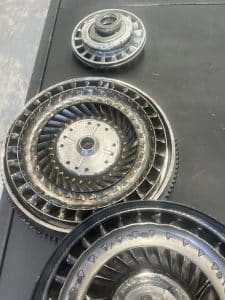
P0736 on Ford Ranger 6R80 transmissions signals
Common symptoms in 6R80 vehicles include delayed engagement into reverse, harsh clunks when selecting reverse, rev flare before movement, or reverse working cold but failing once the transmission is hot. In some cases, the vehicle may intermittently refuse to engage reverse at all. As the fault progresses, limp mode or torque reduction may be triggered, particularly after towing or stop-start driving.
Internally, the cause is almost always hydraulic and mechanical. Reverse operation in the 6R80 relies on specific clutch elements being applied with sufficient pressure to hold load. Over time, clutch friction material wears, seals harden, and internal leakage increases. Valve body wear is a major contributor, particularly in high-kilometre or worked vehicles, as worn bores and valves can no longer maintain the pressure required to fully apply the reverse clutch pack.
Heat accelerates all of this. The 6R80 is extremely sensitive to temperature, and once fluid has been overheated repeatedly, pressure stability suffers. This is why P0736 often appears after towing, reversing uphill, or manoeuvring trailers rather than during normal highway driving.
P0736 on Ford Ranger 6R80 transmissions mistakes
One of the biggest mistakes we see is attempting to fix P0736 with fluid changes, solenoid replacement, or clearing the fault code. Fresh fluid may temporarily mask symptoms, but it does not restore worn clutch material or repair hydraulic leakage. Solenoids rarely cause ratio faults on their own. When P0736 is present, the transmission is already slipping internally, and the ECU is simply reporting what it can measure.
P0736 on the 6R80 as a transmission integrity fault
At Brisbane Tuning & Turbo, we treat P0736 on the 6R80 as a transmission integrity fault, not a generic DTC. Our diagnostic process focuses on validating whether the transmission can still hold load safely. This includes scan data analysis, temperature-based testing, and load validation through controlled road or dyno testing. The objective is to determine whether the transmission is stable, degrading, or at immediate risk of failure.
Depending on the condition of the unit, the correct repair path varies. In some cases, a properly rebuilt and validated valve body can restore pressure control if clutch damage has not progressed too far. In others, torque converter issues contribute to heat and pressure instability and must be addressed at the same time. Where reverse clutch damage is already present, the only reliable fix is a full rebuild using upgraded components designed to survive higher torque and heat loads.
This is where many 6R80 owners are caught out. Reverse slip is rarely isolated. Once it appears, the same wear patterns are usually affecting other clutch packs, even if they have not yet triggered fault codes. Partial repairs without proper validation often lead to repeat failures, wasted money, and ultimately a full rebuild anyway.
Don’t Drive with P0736
Driving with P0736 is risky. Forward gears may continue to operate for a period of time, but every reverse engagement causes additional internal damage, especially when hot. Reversing trailers, parking on inclines, or repeated stop-start use can rapidly accelerate failure. What could have been a controlled repair can quickly turn into a catastrophic transmission failure if ignored.
If your Ranger, Everest, or FPV has logged P0736, the correct next step is a paid transmission diagnostic that validates internal integrity under real operating conditions. Guessing, clearing codes, or replacing parts blindly is what turns repairable transmissions into rebuilds.
If you’re seeing this fault, book a proper 6R80 transmission diagnostic before the damage escalates. Early intervention saves money. Delayed action almost never does.