Reason 6R80 Fail
The Real Reason 6R80 Fail in Australia
Most “reason 6R80 fail” do not begin with a bang, a warning light or a spectacular loss of drive. They begin quietly. Subtly. Invisibly. Long before the driver ever feels a flare, a shudder or a temperature spike, the 6R80 has already entered the early stages of hydraulic decline. The gearbox does not collapse suddenly. It collapses in a sequence. In a strict order. And that order is dictated by heat, torque loading and the pressure stability inside the valve body. In other words: the 6R80 fails hydraulically long before it fails mechanically — and Australia accelerates every step of the process. This is a long read, and if your vehicle has a 6R80 automatic transmission, just read and be equipped with knowledge.
The 6R80 was designed for a very different environment than the one we use it in. On paper, it is a wide-ratio, clutch-to-clutch unit with robust planetaries, excellent torque handling and a reputation for being nearly unkillable behind stock engines. In the United States, where ambient temperatures are mild and towing loads are lighter, that reputation mostly holds up. But transplant the same transmission into Queensland, bolt it behind a high-torque diesel rig, point it up the Toowoomba Range with a caravan behind it, and you’re giving the gearbox a job it was never engineered to do.
This guide is designed for two groups of people: 1) Ford Ranger & Ford Everest owners, and 2) inspired mechanics. The goal is to teach how to diagnose 6R80 fail reasons using only one resource. This article is long, yet it addresses all the 6R80 fail points. Please share this page on your social media.
Reason 6R80s Fail #1
The first problem is heat. Heat is the difference between a healthy 6R80 and a dying one. The converter generates heat, the valve body suffers from it, the clutches glaze because of it, and the ARF fluid breaks down under it. Once ATF temperature rises beyond Ford’s comfortable test window, the entire hydraulic system begins to drift out of spec. The pressure regulator valve becomes unstable. The lockup clutch begins to slip. Solenoids slow down. Separator plate sealing weakens. The shift schedule becomes inconsistent. What the driver feels is a slight flare or a delayed shift. What the gearbox is actually experiencing is the beginning of a pressure-timing collapse that feeds on itself.
Reason 6R80s Fail #2
The second problem is diesel torque. Petrol engines give the converter time to stabilise before torque peaks. Diesels do the opposite. They hit the converter with maximum torque at low RPM — exactly when the converter clutch and valve body are least prepared to handle it. The lockup clutch fights to stay engaged. Slip increases. Heat skyrockets. The fluid thins. Pressure drops. And suddenly, the E-clutch that was designed for smooth transitions under moderate load is being asked to carry diesel torque in Queensland heat with compromised hydraulic support. No clutch pack survives that combination for long.
Reason 6R80s Fail #3
The third problem is tuning. Not bad tuning — just tuning. A tune doesn’t break a 6R80. It simply reveals every weakness earlier. More torque, earlier boost, faster ramp rates and harder lockup transitions demand more precision from the hydraulics. If the valve body is already drifting because of age and heat, a tune is simply the thing that exposes it. Customers often say, “It only started after the tune.” The truth is that the gearbox was already fragile. The tune just removed the safety margin.
Reason 6R80s Fail #4
The fourth problem is age. Every heat cycle the transmission experiences wears the aluminium bores inside the valve body. Eventually, every long climb erodes a little more separator plate material. Every towing trip hardens the converter clutch lining slightly. None of this shows up immediately. The 6R80 adapts, compensates and masks the damage for tens of thousands of kilometres. But once adaptation runs out, the collapse happens quickly — sometimes over a single weekend of towing.
Put these factors together — heat, diesel torque, tuning and age — and you begin to see the real picture. The 6R80 isn’t weak. It’s just living in the wrong country. It wasn’t designed for Queensland summers, 3-tonne caravans, low-speed beach work, repeated converter cycling in traffic, or diesel torque smashing through the lockup clutch at 1,800 rpm. Ford validated the transmission for conditions that look nothing like Brisbane.
So when the 6R80 begins to fail here, it doesn’t fail randomly. It fails in order. First hydraulically, then thermally, then mechanically. The gearbox doesn’t lie; it always tells the truth. You simply need to know how to read what each shift, each flare, each temperature spike and each hesitation is trying to say.
The Predictable Failure Sequence of the 6R80
The 6R80 does not fail randomly. It fails in a strict hydraulic sequence that never changes, no matter whether the vehicle is stock, tuned, towing, old, new or already partially repaired. This is the single most important truth a technician must understand: the 6R80 is a pattern-failure transmission. If you know the pattern, you can diagnose the gearbox with extreme accuracy — often in minutes, sometimes within the first three shifts of a test drive.
Below is the exact sequence the 6R80 follows when it begins to fail under Australian conditions. Every 6R80 we see at Brisbane Tuning & Turbo follows this timeline, whether it arrives at 120,000 km or 320,000 km.
Converter Slip Begins the Downward Spiral
The very first component to fail in a 6R80 is almost always the torque converter clutch (TCC). This is not because the converter is weak. It is because Australian diesel usage forces the converter to lock early, hold lockup longer, and tolerate far more heat than Ford ever designed for.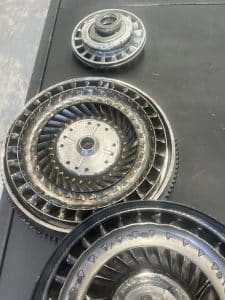
As the converter begins to slip:
ATF temperature rises faster on hills
Modulation becomes inconsistent
The lockup clutch begins glazing
Micro-shudder appears under light throttle
Fuel economy drops without explanation
At this stage, the gearbox still shifts well. Customers rarely complain about shifting — they complain about “heat,” “shudder,” or an odd vibration at 60–90 km/h. They almost never realise this is the start of the failure sequence.
Converter slip → heat → viscosity drop → pressure instability
This is the loop that kills the 6R80.
Heat Destabilises the Valve Body
Once converter heat enters the valve body, the second stage begins. This is where the hydraulics start to drift.
Heat causes: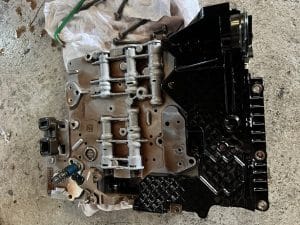
PR valve oscillation
Erratic line-rise
Solenoid thermal fade
Separator plate wear
Checkball seat erosion
The transmission begins losing its ability to regulate pressure under load. This is when the first obvious shift quality complaints appear:
Harsh 2–3
Soft 3–4
Delayed 4–5
Occasional flare under load
But these are symptoms, not causes.
The cause is hydraulic destabilisation from heat.
This is also where many workshops misdiagnose the 6R80. They blame tuning, tyres, sensors or adaptives. In reality, the hydraulics are simply drifting once hot — and diesel torque exposes the drift instantly. Often, they simply recommend automatic transmission service – hoping it would solve the problem
The Mid-Gear Clutches Begin to Slip
Once the valve body can no longer deliver stable feed pressure, the next component to suffer is the intermediate clutch assemblies — especially the C, D and E clutches that manage 3rd, 4th and 5th gear.
The gearbox begins missing its timing windows:
3–4 becomes lazy
4–5 becomes indecisive
5–6 becomes heat-sensitive
Ratios “search” under load
At this point adaptation is working overtime to compensate. The TCM is trying to maintain shift quality by raising or lowering pressure, but it can only mask the problem temporarily. Once adaptives hit their ceiling, the gearbox stops compensating and the driver suddenly feels everything all at once
This is when customers say:
“It was fine last week… now it’s terrible.”
Well, it wasn’t fine.
It was compensating, yet you didn’t know it.
E-Clutch & Overdrive Elements Overheat
As timing drift gets worse, the 6R80 begins slipping during gear-to-gear transitions. Every slip event adds more heat to the system.
This is where the E-clutch — the workhorse of the 6R80 — begins to fail.
Symptoms include:
Soft upshifts once hot
Harsh downshifts
Slow 4–5 confirmation
A “rubbery” 5–6 shift
The E-clutch doesn’t fail suddenly. It loses its oil film, overheats, and begins glazing. The OD clutches suffer next, especially in vehicles that tow or run at 100 km/h for long distances.
When OD elements begin slipping, temperature spikes become dramatic.
A 6R80 that holds 92°C normally will suddenly run at 108°C+ on mild hills.
This is the beginning of thermal runaway.
Full Hydraulic Collapse (The Point of No Return)
Once the converter, valve body and mid-range clutches are compromised, the rest of the transmission goes downhill fast.
Pressure becomes unstable.
Timing becomes unpredictable.
Converter lockup becomes erratic.
ATF shears and oxidises.
Debris enters the cooler and solenoids.
This is when hard faults appear:
3–2 bang
Complete 4–5 flare
Limp mode on hills
Delayed engagement into Drive
Aggressive converter shudder
Drivers often believe this sudden change is “the failure.”
It isn’t.
It’s the end result of a long decline that began a long time ago.
Once the gearbox reaches this stage, a full rebuild is the only reliable option — and the converter is beyond saving.
Why Understanding This Sequence Matters
Because when we recognise a 6R80’s stage of decline:
We quote the repair cost accurately
We prevent unnecessary rebuilds
To your advantage, we turn confusion into clarity repair with expected outcome.
Hopefully, and most importantly, we intervene early, before the gearbox destroys itself.
This is the Redorq advantage – the workframe Brisbane Tuning & Turbo implemented— we don’t guess.
We diagnose based on the exact sequence every 6R80 follows when it fails.
What Owners Feel vs What’s Actually Happening Inside the 6R80
Most 6R80 failures don’t begin with smoke, noise or fault codes.
They begin with feel.
A small hesitation. A slightly late shift. A bit of hunting under load.
Drivers describe symptoms in emotional language — yet the transmission speaks in hydraulics.
When we translate Ford Ranger words into the mechanical truth, reason 6R80s fail becomes incredibly predictable. Every sensation maps directly to a hydraulic event, a failing valve-body circuit, a converter slip pattern, or a clutch element losing apply authority.
Below is what our customers report — and what the 6R80 is really saying.
“It feels fine cold, but when it warms up the shifts go soft or sloppy.”
Owner perception: “Probably needs a service.”
Hydraulic reality: -This is viscosity masking ending.
Cold, thick ATF hides bore wear, PR valve drift and solenoid fatigue.
Once the fluid thins:
Line pressure collapses earlier
The PR valve oscillates
Worn clutch feeds begin leaking
Solenoids lose timing precision
Stage 2 of 6R80 decay
Once this pattern appears, the valve body is already unstable.
It is not a fluid issue.
It is not a tune issue.
This is an early hydraulic failure.
“When I tow, it hunts between gears or gets confused.”
Owner perception: “The tune isn’t right.”
Hydraulic reality: The gearbox cannot maintain timing under load.
Towing amplifies everything:
Converter slip rises
Line rise lags
E-clutch apply pressure becomes inconsistent
The TCM begins choosing the “least bad gear”
Gear hunting is not confusion — it is the 6R80 begging for hydraulic stability.
This is Stage 3 onset.
“It flares when I accelerate onto the highway.”
Owner perception: “Feels like it’s slipping.”
Hydraulic reality: A flare is the 6R80’s most honest cry for help.
A flare means:
The release clutch vented early
The apply clutch did not receive enough pressure
Timing drift has exceeded adaptive limits
This is not random.
Every flare is a mathematical proof that a hydraulic feed — usually the intermediate circuit or 3–5–R passage — is leaking under load.
Flares appear after the converter begins slipping and before full clutch failure.
This is Stage 4 early.
“There’s a shudder at 60–90 km/h under light throttle.”
Owner perception: “Could be tyres, diff, or tune?”
Hydraulic reality: This is converter clutch instability.
The shudder means:
The TCC cannot hold steady slip
The converter lining is glazing
Modulation pressure is drifting
The TCC regulator bore is worn
The converter is already producing excess heat
If shudder is present:
The converter is failing right now — not in the future.
This is the beginning of Stage 3 thermal amplification.
“It’s harsh coming to a stop — like it grabbed suddenly.”
Owner perception: “Feels like a downshift thump.”
Hydraulic reality: The release circuits are no longer venting cleanly.
This is caused by:
Checkball seat erosion
Separator plate distortion
Solenoid release delay
Heat-induced plate warp
Downshifts are pure venting events; they are the truth-tellers.
Harsh 3–2 or 2–1 is one of the earliest visible symptoms of plate deformation.
This indicates Stage 2 → 3 transition.
“It overheats towing even though I’m not pushing it.”
Owner perception: “Must be the cooler.”
Hydraulic reality: The cooler is fine — the converter is slipping.
Overheating without heavy load means:
Converter lockup is unstable
Line pressure is collapsing under heat
Leak points in the valve body are now exposed
The transmission is generating heat faster than it can shed it
By the time the customer sees the temp warning, the ATF has already been too thin for too long.
This is the moment the gearbox crosses into Stage 4.
“It slipped going up a hill for a second, then caught again.”
Owner perception: “Maybe bad fuel? Maybe a one-off?”
Hydraulic reality: This is emerging E-clutch or intermediate clutch failure.
A “slip-then-grab” is a loss of apply authority caused by:
Feed circuit leakage
Collapsing line pressure
Timing drift exceeding solenoid bandwidth
This is the point at which mechanical damage begins.
A 6R80 that does this is now in Stage 5 pre-failure.
“Sometimes it feels like neutral for half a second between gears.”
Owner perception: “Feels weird… like a hesitation.”
Hydraulic reality: The gearbox is losing handover timing.
This is the 6R80’s version of:
“I let go too soon”
“I couldn’t grab fast enough”
It means:
The release clutch vents prematurely
The apply clutch is underfilled
And the system is running out of adaptive correction
This is the last warning before a clutch burns.
“There are no fault codes, so is it really failing?”
Owner perception: “If it was serious, there would be codes.”
Hydraulic reality: Codes only appear after catastrophic timing loss.
The 6R80 will:
Flare without codes
Slip without codes
Shudder without codes
Overheat without codes
Destroy clutches without codes
Why?
Because the electronics trust the hydraulics until the hydraulics fail spectacularly.
The absence of codes is not reassurance —
It is a sign that the gearbox is in early-to-mid failure, not late failure.
The Valve Body as the First Failure Point: Heat, Wear, Drift and Why the 6R80 Loses Control
The 6R80 is mechanically robust. The geartrain holds up well, the clutch assemblies often endure extraordinary abuse before showing symptoms, the pump rarely gives up unless it ingests debris, and even the converter generally tries to maintain lockup integrity longer than expected. But none of these components fail first. The earliest and most influential point of decline is the valve body, the hydraulic brain that determines every pressure decision, timing transition and converter behaviour inside the transmission. The valve body is the first real casualty of Australian usage because it sits directly at the crossroads of heat, pressure, solenoid authority, timing control and converter load. Once it begins drifting out of tolerance, the rest of the gearbox follows it into failure like a row of falling dominoes.
6R80 valve body
The fundamental issue is that the 6R80 valve body was never designed for the environment Australian diesel Rangers and Everests operate in. Ford engineered this hydraulic system for North American temperatures, petrol torque curves, shorter hills, lighter towing loads and driving conditions that rarely expose a transmission to extended heat cycles. In contrast, Australian conditions confront the valve body with 33–42°C ambient temperatures, long hill climbs with GVM-level load, soft-sand driving, repeated converter lock–unlock cycles, early diesel torque arriving at low RPM and trailers weighing 2.5–3.5 tonnes being hauled across the state with no mercy. The valve body was not built for this life. It holds on for as long as it can, then begins announcing its decline through subtle timing drift that eventually becomes impossible for the driver to ignore.
There are several wear points inside the 6R80 valve body that all contribute to the familiar failure pattern.
The first and most consequential is the pressure regulator valve.
This single valve influences nearly everything the transmission does. It must regulate the amount of pressure available to apply and release clutches, stabilise shift timing, maintain converter lockup authority, and manage line rise under load. When the PR valve bore wears, which it inevitably does under Australian conditions, the valve begins oscillating. This oscillation produces an entire catalogue of familiar 6R80 behaviours: harsh or lazy 1–2 shifts, soft or delayed 2–3 transitions under heat, inconsistent line pressure, random downshift thumps, rising ATF temperature and early converter instability. Most 6R80 problems can be traced directly back to the moment the PR valve loses its ability to maintain clean pressure. Once pressure becomes inconsistent, timing becomes inconsistent, and once timing slips, clutches burn.
The second point (equally responsible) converter, regulator and lockup valves
The second critical source of wear involves the converter regulator and lockup valves. These valves dictate how quickly the converter clutch applies, how firmly it holds under load, how much slip it maintains for fuel economy and how much heat is generated during modulation. When these bores wear, the converter begins oscillating instead of holding a clean slip target. That oscillation becomes the first stage of micro-shudder. ATF temperature rises earlier in the drive, and the clutch lining inside the converter begins to glaze. As the glazing progresses, more heat is generated, the converter works harder to maintain lockup, and downstream components such as the E-clutch begin cooking because the valve body cannot keep the converter stable. A slipping converter is not the beginning of failure; it is the symptom of regulator-valve leakage that has already progressed.
The third major wear point lies in the shift-feed circuits
The third major wear point lies in the shift-feed circuits associated with the 3–5–R, 2–6 and E-clutch apply paths. These passages must deliver precise fluid volume at the exact moment the transmission transitions between clutch elements. Once these passage walls erode or the associated checkball seats distort from heat, the automatic transmission begins to flare under load, hesitate during mid-range transitions, bind during downshifts and lose timing consistency. Many automotive mechanics refer to this as “timing drift” as though it were a mysterious electronic behaviour. In reality it is simply hydraulic leakage the control module can no longer hide.
Reason 6R80s Fail #1 Heat
Heat accelerates all valve-body wear. Hot ATF becomes thinner. Thin ATF exposes leakage in every bore. Solenoids lose modulation precision as electrical resistance rises with temperature. Separator plates flex microscopically and allow feed and vent ports to distort. Timing windows shrink. Converter slip increases. Temperature rises further. The clutches lose oil film thickness and begin to graze themselves during apply. This is why so many 6R80s feel crisp when cold, acceptable when warm and completely unacceptable once heat-soaked. The change in behaviour is not random or “just a tune issue.” It is the thermodynamic truth of a valve body reaching the limit of its sealing capability.
Reason 6R80s Fail #2 Tuning
Tuning accelerates valve-body decline because tuned diesels deliver more torque at a lower RPM and in a sharper onset. The valve body is suddenly asked to raise pressure faster, coordinate torque reduction more aggressively, stabilise converter lockup under heavier load and transition clutches cleanly under higher boost. If the PR valve is already drifting, tuning simply exposes the weakness rather than causes it. The shifts begin slipping. Flares become obvious. Converter shudder appears. The E-clutch overheats. ATF temperature spikes on hills that were previously manageable. Customers often believe the tune “broke” the transmission, but in reality, the tune merely revealed the valve-body wear that had been accumulating quietly.
Reason 6R80s Fail #3 Tow
Towing exposes the declining valve body even faster because sustained load forces the converter to modulate slip for much longer periods. The airflow at low towing speeds is poor. Thermal cycling is constant. Gear hunting between fourth and fifth becomes inevitable because the gearbox cannot hold pressure consistently. Downshifts become delayed. The 5–6 transition weakens when hot. Temperature begins climbing earlier in every trip. The gearbox behaves like it is confused, but in reality the hydraulics are losing authority and can no longer execute the TCM’s commands with precision.
Reason 6R80s Fail #4 …Age…
Even age alone is enough to trigger 6R80 decline. After 180,000 to 260,000 kilometres, bores have worn, checkball seats have been hammered repeatedly, solenoids have varnished internally, separator plates have flexed thousands of times, converter clutch cycles have multiplied into the tens of thousands, and the adaptive system has run out of calibration headroom. Even a completely stock vehicle will be well into Stage 2 or Stage 3 of hydraulic wear simply from time and heat.
The valve body is not merely one component. It is the gearbox’s entire hydraulic personality. When it wears, pressure collapses, timing slips, the converter misbehaves, the clutches begin to slip, heat rises, ATF shears, solenoids fade, adaptives saturate and the transmission spirals into failure. When it is corrected properly, the 6R80 becomes predictable, cool-running, stable, strong under load, resistant to shudder, incapable of flare and consistent even during hard climbing or towing. This is why Redorq begins every 6R80 recovery with the valve body. Correct the hydraulics and the gearbox returns to life. Ignore the hydraulics and the gearbox dies — slowly at first, then suddenly.
Why the Torque Converter Fails First (and Why It Takes the Rest of the 6R80 With It)
Every 6R80 failure in Australia begins long before the clutches burn, long before the valve body loses control, and long before the vehicle ever flashes a fault code. The earliest failure point is always the same: the torque converter clutch begins slipping quietly in the background. The converter is the first part of the gearbox to lose its grip on reality, the first source of heat, and the component that quietly poisons the entire hydraulic system until the rest of the transmission cannot cope.
Drivers rarely notice the first stage of failure because the symptoms are subtle. No warning lights appear, shifts still feel acceptable, and the gearbox behaves well enough that the owner assumes it is “just getting older.” But a technician with the right diagnostic method can detect the beginning of converter decline in minutes through temperature behaviour, turbine-speed readings and the faint micro-vibration that appears at light throttle. Converter slip is not an isolated issue; it is the starting point of the 6R80’s most predictable failure chain.
The converter in a diesel Ranger
The converter in a diesel Ranger or Everest is forced to work in a far harsher environment than Ford ever intended for the 6R80 platform. In its original North American petrol applications, the converter sees higher engine speeds, lower torque at lockup, shorter load durations and far less heat during partial slip. Diesel engines, however, deliver their torque early. They ask the converter to lock under heavy load, hold torque at very low RPM, maintain modulation during long inclines, and manage tuning-induced torque spikes. The converter becomes the unofficial heat generator of the transmission simply because it is asked to hold more torque, earlier, for longer.
Modulation instability
The first stage of converter deterioration is called modulation instability. This is the earliest and quietest sign of trouble. At this point the customer might feel nothing more than a faint shimmer or tremor at 60 to 90 km/h under light throttle. Hydraulically, the converter clutch is beginning to lose its ability to hold a stable slip target. The valve body is bleeding pressure in the TCC regulator circuit, the clutch lining is beginning to glaze microscopically, and the solenoid controlling lockup is reacting slightly slower than it should. ATF temperature begins rising earlier in the drive, but not enough for the customer to worry. This stage often lasts tens of thousands of kilometres, during which the gearbox is slowly marching toward its next phase of decline.
Early slip under load
As glazing worsens, the converter moves into the second stage of deterioration: early slip under load. This is where temperature becomes noticeably influenced by terrain, throttle and towing load. Lockup becomes less firm. The transmission spends more time in partial slip. Hills that once posed no stress suddenly produce mild overheating. Customers begin reporting “searching” between gears, soft shifts after long drives or inconsistent converter lockup. Hydraulically, the converter is now generating heat faster than the cooling system can remove it, and the valve body has already lost some authority over TCC regulation.
Converter shudder
The third stage is true converter shudder. This is the first symptom a customer recognises as a problem and often the first time they visit a mechanical workshop at this stage. The shudder appears as a corrugation-like vibration at light throttle, most commonly in fifth and sixth gear around 70 to 100 km/h. The converter clutch’s friction surface is now glazed and shedding particles. The valve body’s regulator circuits can no longer maintain stable slip control. Solenoids, stressed by heat and varnish, modulate inconsistently. The converter begins running hotter than the rest of the transmission, and the clutch debris enters the ATF stream. From this point forward, every kilometre accelerates internal damage. The cooler circuit, the pump, the solenoids and the mid-range clutch circuits now receive contaminated fluid.
Slip escalation
The fourth stage is slip escalation, and this is where the system starts losing control. Lockup becomes unpredictable. The converter oscillates during climbs. ATF temperature spikes within minutes under moderate load. Mid-range shifts in the 3–4 and 4–5 transitions soften, hesitate or flare. The 5–6 shift becomes mushy when hot. Drivers begin to feel the box working harder to perform basic tasks. Turbine-speed logs will show rising slip even under stable throttle. At this point, the converter is failing and destabilising everything behind it. The clutches are still mostly intact, but they are cooking in overheated fluid that is being repeatedly aerated and pressure-starved.
Converter breakdown
The fifth and final stage is converter breakdown. Once the friction material deteriorates enough, the converter becomes a debris pump. Particles enter the pump and valve body, lodge inside solenoid screens, hammer checkball seats, and erode feed passages already weakened by heat. The overdrive clutch circuits begin slipping. Adaptive values saturate as the TCM attempts to compensate for a level of loss that hydraulics can no longer mask. Customers may notice dramatic flares, delayed drive engagement, downshift thumps, thermal warnings or limp mode. By the time the gearbox reaches this stage, the damage is no longer confined to the converter. A full rebuild is generally required.
The converter fails first because the physics of diesel torque and Australian driving conditions force it into its most stressful operating zone every day. Diesel engines demand lockup at the lowest, hottest, highest-load RPM window. Towing forces the converter to maintain partial lockup for far longer than it was designed to. Valve body wear amplifies converter misbehaviour by reducing modulation authority, and solenoid fatigue further destabilises the system. When these three forces combine, converter failure is guaranteed.
Once the converter begins slipping, the rest of the transmission is taken with it. Overheated ATF loses viscosity. Pressure fluctuates. Shift timing drifts. Separator plates warp. Solenoids fade. The E-clutch begins glazing. Overdrive clutch packs lose apply authority. Cooling efficiency declines. Eventually, the gearbox falls into a downward spiral where every system struggles to compensate for the converter’s inability to maintain stable lockup.
Converter instability
This is why replacing only the converter never fixes a failing 6R80. The converter is not the only part that has drifted; the valve body that controls it is already worn, the solenoids are heat-tired, the separator plate is distorted, and the cooler may be contaminated. Installing a new converter without restoring hydraulic authority is essentially placing a healthy heart into a body that can no longer circulate blood properly. The failure returns, often faster than before.
Understanding the converter’s behaviour is one of the clearest signs of 6R80 health. Converter instability reveals the condition of the PR valve, the TCC regulator, solenoid behaviour, separator plate sealing and the overall thermal profile of the gearbox long before the clutches wear out. A technician who reads converter behaviour correctly can diagnose a failing 6R80 hours, weeks or even months before the customer notices anything wrong.
When Brisbane Tuning & Turbo run our Redorq diagnostics on a converter, we do not wait for shudder or catastrophic slip. We read micro-modulation instability, turbine-speed patterns, early lock–unlock oscillation, and the gearbox’s thermal acceleration curve. These subtleties reveal the beginning of converter decline long before it becomes expensive. Correcting the converter early saves the entire transmission. Waiting until the owner feels the failure guarantees a rebuild.
The Mid-Range Clutches: Why 3–5–R, 2–6 and the E-Clutch Fail After Hydraulic Authority Is Lost
Once the valve body begins losing its ability to regulate pressure, stabilise converter behaviour and maintain precise clutch timing, the next components to pay the price are the mid-range clutches. These are the clutches responsible for the everyday work of getting a diesel Ranger or Everest through traffic, onto the highway, up a hill and around town with a trailer behind it. They hold the most torque most often, they apply and release more frequently than the overdrive elements, and they rely on the cleanest, most predictable feed and release circuits in the transmission. When the valve body drifts, these clutches stop being controlled and start being punished.
Mid-range clutch failure does not begin as a dramatic event. It begins as timing inconsistency, almost invisible to the driver. The 3–4 transition becomes slightly soft, especially when hot. The 4–5 feels like it hesitates for a heartbeat before confirming the shift. The 5–6 develops a subtle mushiness on long drives or hill climbs. These are not electronic quirks or occasional miscalculations by the TCM. They are the hydraulic fingerprints of mid-range clutch groups operating without sufficient feed pressure or without a clean release path. The clutches themselves are rarely the villains at this stage. They are the victims of a valve body that is already giving them late, weak or unstable apply signals.
The 3–5–R clutch
The most significant mid-range player is the 3–5–R clutch. In diesel applications, this clutch lives a hard life. It carries significant torque, engages repeatedly during urban driving and becomes deeply dependent on the health of the C- and E-clutch feed circuits. As PR-valve leakage intensifies and heat thins the ATF, the 3–5–R clutch begins receiving inconsistent apply pressure. It holds well when cold, loses authority when warm and falls apart when heat-soaked. The driver experiences this as a flare in the 3–4 shift or a delayed confirmation in 4–5.
Automotive mechanics who chase tuning or solenoid calibrations at this point are treating symptoms rather than causes. What is really happening is that the 3–5–R clutch is being forced to apply with marginal hydraulic support. Every soft apply increases heat, every heat cycle increases wear and every shift becomes slightly more damaging than the last.
The 2–6 clutch
The 2–6 clutch is the quiet achiever of the 6R80. When everything is healthy, the driver never notices its work. But once valve-body authority fades, the 2–6 clutch becomes a subtle but reliable indicator of mid-range instability. It begins to slip just enough for the TCM to compensate, often without setting a code. That compensation alters timing elsewhere, and the transmission as a whole begins to lose coherence. The automatic transmission suddenly feels “uncertain,” even if it is not yet flaring. What the driver is feeling is the 2–6 clutch struggling to maintain apply force while the valve body cannot deliver consistent pressure. It is a whisper of failure long before anything catastrophic occurs.
The E-clutch
The E-clutch is the best-known casualty in aging or tuned 6R80s, but most technicians misunderstand why it fails. They assume the clutch itself is weak or inherently flawed. In reality, the E-clutch is the downstream victim of converter slip and valve-body drift. The E-clutch sits in the firing line of hot, thinned ATF that has already passed through a converter running outside its slip window. It applies under high load, it applies when the converter is working its hardest, and it applies when the gearbox is already hot.
The E-clutch fails because its feed circuit becomes unreliable.
When the valve body cannot supply stable apply pressure, the E-clutch starts taking the load in partial engagement instead of a clean, snappy apply. Partial engagement is mechanical death. It creates heat faster than any cooler can shed it. Over time the E-clutch lining becomes glazed and brittle, the steels become heat-shadowed, and the clutch begins to slip in ways the driver initially perceives as harmless: usually a soft, vague 5–6 shift or a slight flare under tow.
Once any mid-range clutch begins slipping consistently, the gearbox enters a new stage of distress. Adaptives attempt to compensate by increasing apply pressure, adjusting timing and trying to tighten the overlap window between apply and release. For a short while, adaptives can mask the problem. The gearbox may even feel better temporarily. But this is the final calm before the storm. Adaptives cannot compensate for hydraulic leakage indefinitely. Once they reach their limit, the gearbox falls off a cliff. The soft shifts become harsh, the vague transitions become full flares, the occasional hesitation becomes a neutral-drop-like loss of power, and the temperatures that once rose gradually now spike aggressively. By the time the mid-range clutch groups show obvious failure, the valve body is already deep into its decline and the converter has likely been misbehaving for thousands of kilometres.
Mid-range clutch failure is not primarily a clutch problem
The critical truth is that mid-range clutch failure is not primarily a clutch problem. In fact, it is a pressure-control problem. It is a valve-body authority problem. It is a converter-heat and timing-drift problem. These clutches do not burn because they were asked to hold too much torque. They burn because they were asked to hold torque without the oil film thickness, apply pressure or timing stability they depend on to survive. When the hydraulics are restored—when the PR valve is corrected, the TCC regulator is stabilised, the feed circuits are sealed, and the converter behaves properly—the mid-range clutches return to quiet, uneventful, dependable operation.
This is why Redorq’s approach is always hydraulic first and mechanical second. If you correct the root cause early, the mid-range clutches survive. If you do not, the clutches become the next casualties in a failure sequence that began long before any driver felt a symptom.
Overdrive Elements & High-Gear Fragility: Why the 6R80 Dies Quietly at the Top End
By the time most drivers notice a real problem in a 6R80, the overdrive elements have already begun to fail. These are the smallest, most thermally sensitive, least-forgiving clutches in the entire gearbox. They live at the end of the hydraulic chain, at the point where line pressure is lowest, leakage matters the most, converter stability matters completely and separator-plate distortion becomes fatal. When the mid-range clutches begin slipping, the driver can feel it. When the overdrive clutches begin slipping, the gearbox stays quiet—for a while. This is why the 6R80 often appears “fine one day and ruined the next.” It isn’t sudden. It is the delayed revelation of damage that has been accumulating invisibly inside the highest gears.
Overdrive failure
Overdrive failure starts long before it becomes perceptible. It begins with the converter’s inability to maintain stable lockup at highway speeds. When the converter is slipping microscopically at 80 to 110 km/h, the driver feels nothing more than a soft oscillation that they often describe as “wind buffeting” or “road surface vibration.” In reality, the TCC is modulating erratically because the valve body can no longer hold clean pressure. Every tiny oscillation generates heat, and that heat flows directly into the overdrive clutch circuits. These clutches have no tolerance for heat. Their surface area is small, their feed passages are narrow and their hydraulic window is tight. They depend on clean, stable pressure and a converter that is behaving properly. When neither of those conditions is present, the overdrive section begins to wear quietly in the background.
Overdrive distress
The first true sign of OD distress is instability in the 5–6 shift. At moderate throttle, the transmission may feel slightly soft, lazy or vague. At higher temperature, the transition becomes less defined. If the vehicle has been towing, climbing or cruising on a warm day, the 5–6 shift begins to reveal its weakness through small timing irregularities that most drivers brush off as “normal for an older ute.” This is the overdrive feed circuit beginning to leak. The clutch is not applying with the firmness it once had, and the release clutch is not venting as cleanly, which creates overlap or gap depending on temperature. The gearbox is already compromised, even if the driver still thinks it is liveable.
As leakage progresses, the automatic transmission begins to hunt between fifth and sixth on light inclines. It may shift into sixth, reconsider, drop back into fifth, then attempt sixth again. Many drivers assume this is tuning, tyre size or road gradient. It is not. It is the overdrive clutch group no longer receiving enough apply force to maintain the intended ratio. The TCM wants sixth gear. The hydraulics refuse to deliver it. This is the moment when the overdrive section begins transitioning from “slightly worn” to “approaching thermal collapse.”
The 5–6 handover
Once the gearbox loses consistent control of the 5–4–5 range, the 5–6 handover begins to unravel. This shift is the first true overdrive event—small clutch packs, narrow feed circuits and almost no margin for leakage. When the gearbox is hot or the converter is slipping, the 5–6 transition may flare slightly, or it may bump twice, or it may feel like it “breathes” during the apply. These sensations are not tuning errors. They are the mechanical expression of an overdrive clutch pack losing its authority. At this stage, every shift produces more heat. Every heat cycle exaggerates leakage. Every leakage event affects timing. The spiral accelerates.
The 6–lockup event
The 6th-gear lockup apply is often the first truly alarming moment for many drivers. It may present as a double-bump, or a grab–release–grab sensation during converter clutch application. This behaviour means the converter applied, immediately lost feed pressure, and then re-applied as the TCM commanded more pressure in an attempt to save the event.
This is early overdrive feed collapse.
It is the hydraulic equivalent of a heart skipping a beat.
The gearbox is not confused; it is failing.
From here, the downward slope is steep. Sixth-gear operation becomes inconsistent at highway speeds. The gearbox begins to shuffle slightly under light load. RPM may vary subtly. Turbine speed may oscillate. Temperatures drift upward sooner in every drive. This is the point where the overdrive section is no longer holding with full surface contact—elements are beginning to slip. The driver may notice nothing more than “busy” behaviour. But busy is not a characteristic. It is a symptom. It is hydraulic fragility pretending to be normal.
The final stage of overdrive decline
The final stage of overdrive decline is instability in 6th gear during steady-state cruising. Overdrive in the 6R80 relies on minimum line pressure, correct lubrication, and a converter clutch working inside a tight slip-control window. When 6th hesitates, or lockup feels indecisive, the gearbox is announcing that its overdrive section is structurally compromised.
If shudder develops, the converter clutch is now glazed beyond recovery.
If the gearbox hunts in the 90–110 km/h range, the valve body is out of authority and the overdrive clutches are applying with little more than residual friction and momentum. At this stage, the transmission is not operating; it is surviving.
Overdrive failure in the 6R80 is quiet.
The gearbox is intentionally calibrated to hide weaknesses in its highest gear for driver comfort. TCM strategy smooths shifts, delays lockup, blends torque reduction and allows controlled slip to maintain refinement. These strategies mask hydraulic decay until the final weeks of the transmission’s service life. By the time symptoms become obvious, the gearbox is no longer in early decline; it has already completed most of the failure sequence.
The fragility of the overdrive section is not a design flaw. It is a calibration mismatch. Ford did not build the 6R80 for repeated towing up Cunningham’s Gap, for long-range caravanning at GCM, for hot Queensland ambient temperatures or for tuned diesels producing torque far earlier and heavier than any North American petrol platform. The overdrive section was designed to cruise gently, not carry load uphill at 1,700 rpm on a summer afternoon. When asked to do the latter, it simply runs out of hydraulic headroom and mechanical surface area.
This is why Brisbane Tuning & Turbo Redorq treats overdrive behaviour as one of the clearest diagnostic indicators of impending 6R80 failure. A transmission that is unstable in the upper gears is no longer drifting; it is approaching collapse. The failure began in the valve body. The mid-range clutches suffered next. But it is the overdrive section that reveals how close the gearbox is to the end of its serviceable life. Correcting the hydraulics early prevents this. Ignoring the early signs leaves you with a gearbox that appears to die quietly, suddenly and without warning—when in reality it has been telling the truth for years.
The Cooling Mismatch: Why Temperature Finishes Off an Already-Struggling 6R80
If hydraulic wear is the disease inside a 6R80, heat is the accelerant that pushes the transmission over the edge. Heat does not start the failure, but it amplifies every weakness the moment the valve body begins drifting, the converter begins slipping and the mid-range clutches begin losing apply authority. The 6R80’s cooling system was never designed for the way Australian Rangers and Everests are used. It was calibrated for North American climates, lighter towing demands and petrol torque delivery. That mismatch becomes fatal in Queensland, where temperature exposes hydraulic weakness faster than any scan tool ever could.
Stock Cooling System
The stock cooling system works adequately when the gearbox is new, the valve body is tight, the converter is behaving and the clutches are applying cleanly. But once any of those systems drift, heat becomes the truth serum that reveals the damage occurring beneath the surface. ATF that stays within the 80 to 95°C band behaves predictably. It provides sealing, cushioning, hydraulic stiffness and thermal stability. But once temperatures rise above the low 100s, the properties of the fluid change dramatically. Viscosity drops. Film strength decreases. Solenoid response becomes less precise. Bore leakage increases. Converter slip escalates. Timing windows shrink. The gearbox that functioned reliably cold begins to fall apart under heat soak, especially on long inclines or during towing.
The cooling mismatch begins with the thermostat-controlled bypass that governs when fluid flows through the cooler. Ford designed this system to assist the gearbox in reaching operating temperature quickly in cold climates. That design makes sense in Canada. It makes no sense in Cairns. The thermostat delays cooling at the exact moment a diesel 6R80 is producing the most converter heat—low-speed climbs, off-road load, trailer reversing, hill starts and slow urban towing. The converter clutch is modulating aggressively in these conditions, trying to maintain lockup at low RPM. Valve-body leakage increases because the ATF is already warm. Pressure stability becomes inconsistent. All of this heat is created before the cooling system has even opened properly. By the time the thermostat allows flow, the damage is already in motion.
Heat
Heat also exposes the weakness in the separator plate. The thin steel plate separating valve-body circuits flexes microscopically when exposed to prolonged high temperatures. That flex distorts feed and vent holes and erodes checkball seats. Once these apertures deform, clutch feed circuits begin leaking, particularly in the mid-range and overdrive zones. The gearbox may shift perfectly cold, adequately warm, and then fall apart once heat-soaked. Drivers describe this as “moodiness” or “inconsistency,” but it is simply the separator plate warping under thermal stress and altering the volume and timing of hydraulic flow.
Overheated ATF also weakens the solenoids that control clutch modulation.
Solenoid coils increase in electrical resistance when hot. That change slows the response time of the plunger, and even a few milliseconds of delay changes shift timing dramatically. A solenoid that performs well cold may become erratic once temperature rises. The result is a mid-range flare, a late torque-reduction synchronisation, or a double-bump on downshifts. The driver notices the behaviour but not the cause. To them, it feels “random.” To a trained eye, it is the unmistakable signature of solenoid thermal fade triggered by a gearbox already running too hot.
Heat affects the converter more aggressively than any other component. A converter that is slipping generates heat faster than the cooler can shed it. Once the converter clutch begins to glaze, the clutch surface loses friction stability. The converter then oscillates more severely, generating even more heat. It becomes a feedback loop. Slip creates heat. Heat thins the fluid. Thin fluid reduces pressure. Reduced pressure increases slip. Increased slip creates more heat. The transmission enters thermal runaway without the driver understanding why temperatures are climbing on hills they used to ascend comfortably.
Hydrodynamic lubrication
The lubrication network also reacts poorly to high temperatures. Thin ATF loses its ability to maintain hydrodynamic lubrication on clutch steels. The oil film breaks earlier during apply. The clutches engage more abruptly or more softly depending on the exact thermal condition. The geartrain itself, though strong, receives hotter, thinner oil that evaporates faster from rotating components. In high-mileage gearboxes, this reduction in lubrication film accelerates wear on thrust washers and bushings, especially in the overdrive section.
The cooling system’s final weakness appears once debris enters the fluid. A failing converter sheds microscopic particles into the ATF. These particles travel through the cooler, lodge in the narrow passages of the thermal bypass, cling to solenoid screens and impede fluid flow. As flow decreases, the cooler becomes less effective. The transmission now overheats even during light driving. Drivers often assume external conditions are to blame—“It was a hot day,” “I was carrying a bit of weight,” “The hill was steeper than I remembered”—but the real issue is that debris inside the network has reduced cooler efficiency by twenty to forty percent without any visible symptom.
Australian factor
And then there is the Australian factor. Queensland does not give a gearbox any thermal mercy. Ambient temperatures in the low to mid 30s mean the transmission begins every drive closer to its thermal ceiling. Humidity reduces the ability of the cooler and radiator to shed heat. Long highway climbs force the converter to work at the worst possible RPM. Urban towing eliminates airflow. Sand driving increases load while dramatically reducing vehicle speed. All of this contributes to a state where the gearbox spends far more time in the temperature bands that expose wear and accelerate decline.
The critical truth about heat is this: temperature does not destroy a healthy 6R80. It destroys a 6R80 that has already begun to drift. Temperature is the finishing blow, not the opening punch. A gearbox with a tight valve body, a stable converter clutch, consistent solenoid operation and a clean lubrication network can manage heat reasonably well. A gearbox with hydraulic leaks, unstable converter modulation and worn mid-range feeds cannot. Once temperature climbs, the gearbox reveals exactly how ill it already is.
Brisbane Tuning & Turbo Redorq
This is why Brisbane Tuning & Turbo Redorq treats cooling behaviour as a diagnostic tool rather than an afterthought. A 6R80 that overheats on hills, delays cooling at the crest, or climbs in temperature without load is not suffering from poor airflow or a marginal cooler—it is telling you its hydraulics are out of tolerance. Fix the hydraulics early, and the cooling system becomes adequate again. Ignore the hydraulics, and the cooling system becomes overwhelmed, no matter how many aftermarket parts you bolt on.
The cooling mismatch is not a design flaw. It is a calibration mismatch between Ford’s intended usage and the reality of Australian diesel life. When the hydraulics drift and the heat rises, the 6R80 has no room left to stabilise itself. Temperature becomes the judge, jury and executioner. It does not matter how good the rest of the gearbox is—the coolant strategy finishes off what the valve body, solenoids and converter have already begun.
Adaptive Strategy, Timing Drift & Why the 6R80 “Feels Fine Until It Doesn’t”
The 6R80 has one of the most forgiving adaptive strategies Ford ever wrote. It was designed to keep a transmission “acceptable” for as long as possible, even as the hydraulic system slowly drifts out of tolerance. This behaviour is fantastic for American petrol SUVs cruising in cool climates. But in Australian diesel utes towing through thirty-five-degree heat, this same adaptation system masks deterioration until the gearbox is already deep in its failure curve. By the time the customer feels something wrong, the damage is no longer subtle—it is structural.
The adaptive system’s job is simple: learn how much fill time, release timing and clutch pressure the gearbox requires as it ages. When a bore wears slightly, the TCM increases pressure. When a solenoid slows down, it adjusts the apply ramp. Once a separator plate begins to deform under heat, the TCM stretches or compresses timing values to prevent flares or overlaps. It does this quietly, constantly, and invisibly to the driver. The gearbox always feels “fine” because the TCM keeps massaging timing in the background, smoothing out the symptoms.
But here is the engineering truth no customer hears: every adaptive correction indicates a loss of hydraulic authority. Adaptives are not magic—they are compensations for mechanical wear. They do not reverse damage. They simply hide it.
Adaptive correction
The trouble begins when the adaptive range is no longer enough to compensate for the deterioration inside the valve body, solenoids and separator plate. Once the wear passes a certain threshold—usually accelerated by Queensland heat, towing load or diesel tuning—the TCM reaches the end of its correction window. It can no longer disguise the drift. Overnight, the gearbox transforms from “fine yesterday” to “problem today,” even though the underlying wear has been progressing quietly for tens of thousands of kilometres.
This “cliff effect” is what shocks Ranger and Everest owners. They believe the transmission failed suddenly because the symptoms appear suddenly. But the hydraulics have been failing slowly, predictably and measurably for months. The TCM simply ran out of headroom to mask the decline.
Timing drift
Timing drift is the moment when adaptive learning fails to keep the clutch-to-clutch transitions aligned. In a healthy 6R80, one clutch lets go at the exact moment the next clutch applies. When the PR valve wears, when the mid-range clutch feeds leak, when solenoids grow inconsistent under heat, that perfect balance is disrupted. The adaptation system tries to correct it. It nudges fill times upward. It delays or advances torque reduction. Also, it increases solenoid current. It trims the release. But once the drift is larger than the adaptive margin, the shift either flares, bangs, double-steps or hesitates.
Customers describe timing drift as “it hesitated before shifting,” “it grabbed then let go,” “it flared a little on the hill,” or “it’s fine until it’s hot.” All of these are evidence that the adaptive system is losing its battle against hydraulic leakage.
6R80 viscosity-dependent
What makes the 6R80 especially deceptive is that timing drift appears inconsistently at first. A gearbox may behave perfectly on a cool morning, then flare during the afternoon commute, then behave fine again the next day. This inconsistency is not random—it is viscosity-dependent. As ATF thins with heat, leakage increases. Once leakage increases, pressure stability evaporates. As pressure evaporates, timing drift appears. When the transmission cools again, the fluid thickens and masks the problem. This cycle repeats over and over until the gearbox crosses into permanent drift.
Diesel torque
Diesel torque accelerates timing drift further. The TCM expects a certain torque curve when calculating how aggressively to reduce power during shifts. Diesel tuning dramatically increases low-RPM torque, which compresses the timing window. The clutches must complete the handover faster and under more load. When hydraulic drift is present, the TCM cannot correct the mismatch, no matter how advanced its strategy is. That is why tuned Rangers often “fail suddenly” even though the owner believes the tune itself caused the issue. The tune didn’t break the transmission—the tune simply exposed drift that the adaptive system could no longer hide.
The final stage of adaptive collapse occurs once multiple circuits inside the valve body degrade simultaneously. The PR valve begins to oscillate. The converter regulator leaks enough that the TCC slip pattern becomes erratic. The mid-range feeds lose their ability to maintain apply pressure. The solenoids become heat-sensitive and inconsistent across the temperature band. By this point the TCM has exhausted its learning tables. There is no more adaptation available, and the gearbox becomes unstable across multiple gears.
Zone-specific hydraulic decline
This is why a 6R80 can feel acceptable in 1–2 and 2–3 while simultaneously flaring in 3–4 and slipping in 5–6. Zone-specific hydraulic decline overwhelms zone-specific adaptations. The transmission is no longer receiving clear hydraulic signals, and the TCM is no longer able to reinterpret them. The result is the unmistakable feeling of a gearbox that “acts differently every day,” a behaviour that always precedes full failure.
Once timing drift becomes visible to the driver, the mechanical damage has already begun. The E-clutch experiences partial apply events that generate unnecessary heat. The converter oscillates more often during mid-range cruising. The ATF overheats on hills as slip increases. Clutch steels lose lubrication film due to pressure lapses. The spiral is now fully active: drift leads to heat, heat leads to instability, instability leads to slip, slip leads to more heat, and eventually the clutch packs reach their limit.
The cruel irony is that customers rarely see any fault codes during this descent because the TCM only sets a code when timing errors exceed a fixed threshold. Most hydraulic deterioration stays within the error window until the very end. By the time codes finally appear, the problem is no longer hydraulic—it is mechanical. The gearbox has already burnt a clutch or damaged the converter, and predictive intervention is no longer possible.
Reading shift quality, not reading codes
This is why the Brisbane Tuning & Turbo Redorq program prioritises reading shift quality, not reading codes. Timing drift is audible, tactile and predictable long before it is electronically measurable. A trained technician can hear it, feel it, and interpret it instantly. A customer can sense something “not quite right” even if they don’t have the vocabulary for it. The adaptation system can hide the truth, but only for so long. Once drift appears, the system has reached the end of its authority.
And that is the real reason the 6R80 “feels fine until it doesn’t.” It has been failing slowly with the TCM smoothing out the symptoms—until the wear grows so severe that no amount of adaptive correction can conceal the truth anymore.
Converter Behaviour Under Load: Why Diesel Torque and Towing Break the 6R80 Faster
If the valve body is the hydraulic brain of the 6R80, then the torque converter is its pressure amplifier and thermal regulator. It is the first component to absorb torque, the first to generate heat, and the first to reveal whether the transmission truly understands the load being applied to it. Every 6R80 that fails under towing or diesel tuning has one thing in common: the converter begins losing stability long before any mechanical component breaks. Most owners never recognise the earliest converter symptoms because, unlike a clutch pack that burns loudly, the converter fails quietly. It whispers, and only a transmission technician who understands its language hears the warning.
The 6R80 converter
The 6R80 converter was never designed for the torque characteristics of modern Australian diesel utes. Ford calibrated it for North American petrol engines, which ramp into torque more gradually, produce less low-RPM load, and rarely tow at full GVM through extended heat-soak conditions. Petrol engines allow the converter to lock under relatively low stress. Diesel engines do the opposite. They request full lockup under high load and at far lower RPM, which forces the converter clutch to absorb torque spikes in the most punishing part of the RPM band. A tuned Ranger peaks torque at 1600–2200 rpm; a converter clutch hates torque at that range because turbine speed is too low for clean lockup. The clutch ends up slipping microscopically, generating heat every second it is engaged. That heat radiates through the rest of the gearbox until the entire ATF supply begins drifting into thermal instability.
Towing with 6R80
Towing amplifies this behaviour tenfold. On a hill climb at 1100–2000 rpm, the converter is not simply passing torque. It is attempting to maintain a delicate balance between slip and lockup. At low speeds, airflow across the cooler drops. The converter produces more heat per revolution because the diesel engine is lugging (click to read more about lugging here). The valve body, already warm, struggles to maintain stable modulation pressure. That instability lets the converter slip slightly during load transitions. That slip creates more heat, which thins the ATF, which destabilises the PR valve, which further destabilises converter control. Once this loop begins, a fully healthy converter can be pushed into glaze formation in a single long climb up the Toowoomba Range.
Heat is the converter’s real enemy, not torque alone. Heat compromises the friction lining. And heat reduces ATF viscosity. Silently, heat destabilises the valve body circuits that hold the clutch. In fact, heat accelerates the varnish formation inside the solenoids responsible for modulating lockup. Heat expands the converter shell and changes its internal thrust geometry. A converter that slips only slightly at 85°C will slip five times worse at 110°C. And this is exactly the temperature window a towing Ranger lives in up every major hill in Queensland.
Converter clutch story
The converter clutch lining tells a story when you pull the converter apart. Light glazing means the clutch has been slipping gently for months. Heavy glazing means it has been slipping at high temperature.
Chunking means the converter has been in thermal runaway. Scoring and metal transfer indicate catastrophic overheating. What most owners don’t realise is that converter glazing begins long before they ever feel shudder. By the time shudder appears, the converter is already deep into Stage 2 failure. At that point the converter is no longer correcting itself—it is self-destructing through friction instability.
The converter is also the first component to expose the mismatch between tuning and hydraulics. A mild tune that increases torque by thirty percent can take the converter from “barely stable” to “constantly fighting for traction.” A tune that increases torque fifty percent or more can overwhelm the converter even under casual acceleration. Customers often blame the tune for “making the gearbox fail,” but the truth is simpler: the tune merely exposed a converter clutch that was already losing the microscopic battle against slip. Once the converter begins slipping, it begins heating the entire transmission. Subsequently, once the transmission overheats, every hydraulic component drifts. Once the hydraulics drift, clutch timing falls apart. By the time the gearbox feels bad, the converter has been silently cooking it from the inside.
Converter failure
There is also a structural aspect to converter failure that is often overlooked. As the converter overheats, thrust surfaces begin wearing. The converter’s internal thrust washer or bearing begins producing fine debris. That debris enters the pump first. The pump begins scoring, which reduces volumetric efficiency. Line pressure drops slightly. That drop accelerates the timing drift already underway. Feed circuits that were “just holding on” begin failing because the pump pressure can no longer support marginal valve body seals. This is why converters, not clutches, are the silent killers of 6R80 transmissions. The converter is upstream from every hydraulic circuit. When it fails, it contaminates the system quietly and comprehensively.
Towing with 6R80
Towing—especially slow-speed towing—finishes the job. At slow speeds, the converter stays unlocked longer. Diesel torque pulses load the turbine unevenly. The clutch operates in and out of modulation constantly. The converter never cools because there is no airflow. The ATF entering the gearbox is already hotter than what the valve body can tolerate. By the time the cooling system finally engages, the converter has already created a heat spike that takes minutes—not seconds—to dissipate. On a long climb, those minutes never arrive. Temperature climbs relentlessly until the converter, separator plate and valve body all move out of their proper operating windows.
Once the converter loses authority, the rest of the transmission stops behaving. Overdrive clutches begin losing apply strength. The E-clutch begins taking more heat load than it was designed for. Adaptive learning stretches into its final inch of compensation. The gearbox starts hunting for gears because it can no longer maintain stable lockup. Highway shudder becomes the customer’s first hint that something is wrong, but the real damage occurred thousands of kilometres before that vibration ever appeared.
Brisbane Tuning & Turbo Redorq diagnostic
This is why, at Brisbane Tuning & Turbo Redorq diagnostic check points, converter behaviour is one of the first and most heavily weighted diagnostic indicators. If the converter is misbehaving, even subtly, the technician knows the gearbox is already in thermal decline. It is not the converter alone that is failing—it is the entire hydraulic regime that surrounds it. Fix the valve body early, correct the converter’s modulation window, stabilise the PR valve, and the converter becomes a predictable, cool-running, low-stress component again. Ignore the early converter signals, and the gearbox becomes a thermal runaway event waiting to happen.
The 6R80 was not engineered for the diesel torque and towing behaviour Australians demand from it. The converter absorbs the mismatch first. The hydraulics amplify it. The clutches pay for it. By understanding converter behaviour under load, you understand why so many 6R80s fail the same predictable way—and why preventive hydraulic correction is the most powerful way to stop the cascade before it destroys the entire unit.
The Downhill Spiral: How a Worn Converter, Valve Body & Heat Create a Self-Accelerating Failure Loop
Every failed 6R80 tells the same story. It begins with microscopic valve-body wear, continues with converter instability, accelerates through heat, and ends with clutch destruction. Customers describe the failure as “sudden,” but the gearbox has been giving warnings long before the symptoms became loud enough to notice. The 6R80 does not die from one event; it dies from a cascading sequence of hydraulic imbalances that feed into each other until the transmission can no longer maintain control.
Stage 1- Valve body failure
The spiral always begins in the valve body. The pressure regulator valve wears first, causing tiny fluctuations in line pressure. These fluctuations are so small the driver cannot feel them, but the converter can. The converter clutch begins modulating under inconsistent pressure, slipping microscopically during low-RPM load. That slip generates heat at the converter outlet — the hottest point in the entire transmission. Once hot, the ATF thins, and the valve body’s worn bores leak more aggressively. The extra leakage amplifies the pressure instability already underway, and the converter slips even more. The gearbox has now entered the first stage of the spiral: pressure instability feeding heat, and heat feeding pressure loss.
6R80 stage 2 failure -The separator plate role
As temperature rises, the separator plate begins flexing. This flexing alters clutch feed timing and creates inconsistent apply rates across the mid-range gears. The solenoids, now operating in hotter, thinner fluid, begin losing modulation authority. Their response time slows, forcing the TCM to stretch adaptives to keep shifts clean. But adaptives are finite; every adjustment the TCM makes pushes the gearbox closer to the point where timing drift becomes unmanageable. At this stage the customer may begin noticing small flares or soft shifts when hot, but the transmission will still behave acceptably when cold. This pattern is not random — it is the second stage of the spiral, where viscosity-sensitive wear becomes visible only under heat load.
As the converter continues slipping under diesel torque or towing conditions, temperature rises faster than the cooler can dissipate. The thermal bypass valve delays cooler flow just long enough for the converter to cook the fluid again and again. The ATF begins oxidising and shearing. Its ability to cushion clutch engagement decreases. Its ability to hold pressure under load collapses. The valve body now operates in fluid that no longer supports stable hydraulic behaviour. The PR valve oscillates harder. The converter regulator valve leaks more. The shift feeds lose authority. This is the moment where timing drift becomes obvious: the famous 3–4 flare, the uncertain 4–5 transition, the soft 5–6 under load.
Timing drift & Clutch temperature -the 3Rd Stage
Once timing drift appears, clutch temperatures begin rising. The E-clutch, already the smallest and most thermally exposed clutch in the 6R80, becomes the first to suffer. It begins applying on a thinner oil film. The steels begin showing heat tint. The frictions begin glazing. Lubrication inside the drum becomes inconsistent because viscosity drops at the exact moment the clutch needs the most stable oil film. The clutch begins losing torque capacity. The TCM, unaware of the mechanical deterioration, simply increases pressure to compensate. Pressure increase generates more heat. More heat accelerates glazing. This is the third stage of the spiral: the clutches themselves enter thermal runaway.
The 4th Stage of 6R80 fail
Meanwhile, the converter is shedding debris. The thrust washer or bearing begins wearing due to repeated high-heat cycles. Metallic particles begin circulating in the ATF. These particles enter the pump first, scoring the pump’s gears and reducing its volumetric efficiency. Reduced pump flow means reduced available pressure at the valve body. And reduced pressure means reduced clutch apply authority. Reduced clutch apply authority means increased slip. Increased slip means more heat. At this stage the spiral is irreversible without full mechanical intervention. This is the fourth stage: contamination amplifies every weakness and begins damaging components that were previously healthy.
The Pump Story
Once the pump begins losing efficiency, the lubrication network becomes compromised. Overdrive elements receive less oil. Planetaries receive oil at higher temperature and lower volume. Bushings wear faster. Even the torque path alignment begins deteriorating because lubrication is no longer cooling thrust surfaces evenly. The gearbox now behaves unpredictably. Some shifts hit harder than expected. Others flare. The converter may lock, unlock, relock or oscillate. The customer may notice shudder at 70–90 km/h, but by now the shudder is simply the audible soundtrack of an entire hydraulic system collapsing.
Failed TCM story
Eventually, the adaptive system reaches its limit. The TCM cannot stretch timing any further. The gearbox begins running out of correction headroom. The driver feels the inevitable: harsh downshifts, late torque-reduction intervention, flares when overtaking, temperature climbing on hills that used to be effortless. The 6R80 is no longer adjusting — it is reacting. Once the TCM can no longer compensate, the clutches begin slipping mechanically rather than hydraulically. The E-clutch burns first. The C or B clutch follows depending on driving style. The converter clutch loses traction completely. And at this point, the gearbox that “failed suddenly” has actually been in hydraulic decline for tens of thousands of kilometres.
The true nature of the 6R80 failure spiral
This is the true nature of the 6R80 spiral. It is a feedback loop. Hydraulic leakage leads to converter slip. Converter slip leads to heat. Heat leads to viscosity collapse. Viscosity collapse leads to greater hydraulic leakage. Leakage leads to timing drift. Timing drift leads to slipping clutches. Slipping clutches lead to more heat. More heat leads to contamination. Contamination leads to pump wear. Pump wear leads to starvation. Starvation leads to complete mechanical failure. The speed of the spiral depends on load, temperature, towing habits and tuning — but the sequence never changes.
At Brisbane Tuning & Turbo Redorq’s philosophy is built on interrupting this loop early. Fix the valve body before the converter begins slipping. Fix the converter before it begins shedding debris. Stabilise hydraulics before adaptives saturate. Keep ATF temperature below the thermal tipping point. Most 6R80s don’t need to fail. They fail because owners and uneducated mechanics miss the first three or four stages of the spiral — the silent stages that tell you exactly what the gearbox is about to do long before it becomes expensive.
The Three Failure Paths of the 6R80 (Tow, Tune, Age) and How Each One Follows the Same Spiral
Every failed 6R80 reaches the same endpoint — heat, slip, glazed clutches, converter breakdown and hydraulic collapse — but the starting point differs depending on how the vehicle is used. Some transmissions fail because towing pushes the converter past its thermal capability. Some fail because tuning amplifies the valve body’s weakest points. Others fail simply because time, kilometres and normal driving wear the hydraulic network down. But although the triggers differ, the failure path itself is identical. The 6R80’s architecture ensures that all roads eventually converge into the same downward hydraulic spiral once the valve body loses control.
Towing begins the spiral with heat, not torque.
Towing begins the spiral with heat, not torque. The converter remains unlocked for longer during climbs and heavy load, generating enormous slip energy. That slip produces thermal spikes at the converter outlet, which the cooler cannot dissipate quickly enough — particularly in Queensland conditions. This early, repeated heat cycle thins the ATF, exposes the PR valve bore wear, and destabilises the converter regulator valve. As the converter begins slipping inconsistently, the E-clutch and 3–5–R circuits downstream begin seeing hotter, thinner fluid than they were ever meant to tolerate. The result is predictable: the gearbox becomes temperature-sensitive, mid-range shifts soften, and converter shudder appears on light load. Towing does not destroy the 6R80 mechanically — it accelerates the hydraulic deterioration that was already happening quietly in the background.
Tuning
Tuning follows a different path, but the destination is the same. Diesel torque arrives early and aggressively, demanding immediate line pressure from a valve body that already has microscopic wear. Increased torque does not damage the clutches directly; it challenges the PR valve, the converter regulator valve and the 3–5–R feed circuits to respond faster than their worn bores can manage.
The effect is subtle at first: a soft 3–4 shift under load, a flare during overtaking, a slight converter shimmer at highway speed. But tuning amplifies every existing weakness. The solenoids now operate inside narrower timing windows, and the TCM must intervene more often with torque reduction to prevent flares. Once the valve body falls even a little behind, timing drift begins and the tune exposes the hydraulic truth the factory calibration was masking. Tuning doesn’t kill a healthy 6R80 — it simply refuses to hide the wear.
Age or wear
Age follows the slowest and quietest path, but it ultimately leads to the same decline. Years of thermal cycling, countless lock/unlock converter cycles, varnish accumulation, separator plate flexing and mechanical vibration gradually reshape the valve body’s internal tolerances. The PR valve bore wears to the point where cold shifts become crisp but hot shifts go soft. Solenoids lose linear modulation, and the separator plate’s checkball seats flatten. Downshifts begin thumping, upshifts begin hesitating, and converter lockup becomes less consistent. None of these behaviours are dramatic on their own, so the driver often thinks the gearbox is simply “getting old” or “acting like a typical Ranger.” In reality, age-induced wear has already placed the gearbox on the same highway to failure as a tuned or towing unit — the difference is only in how fast the vehicle travels down that highway.
Despite their different triggers, all three paths converge at the same sequence of deterioration. As soon as the valve body loses its ability to regulate pressure consistently, the converter begins slipping more than the TCM expects. That slip raises temperature. Higher temperature thins the fluid. Thinner fluid increases leakage at worn bores. Increased leakage weakens clutch apply pressure. Weak clutch apply pressure forces the TCM to stretch adaptives, increasing timing correction. Increased correction leads to timing instability. Timing instability leads to slip under load. Slip generates more heat. Heat damages the converter. The converter sheds debris. The pump ingests that debris. Flow drops. Lubrication collapses. The E-clutch overheats. And then, suddenly, the transmission that “felt fine last week” becomes undriveable.
The spiral always looks sudden
This spiral always looks sudden to the customer, even though hydraulically it has been advancing for tens of thousands of kilometres. Whether the catalyst was towing, tuning or simple age, the underlying mechanics are identical: the valve body drifts, the converter loses authority, the ATF loses viscosity, and the entire hydraulic system collapses under heat. That is why Brisbane Tuning & Turbo Redorq treats tow/tune/age transmissions — by restoring the hydraulic foundation before mechanical damage becomes irreversible.
Early Warning Signs: The Subtle Behaviours That Indicate a 6R80 Is Entering the Spiral
A failing 6R80 rarely announces itself with dramatic symptoms in the beginning. The early warning signs are subtle, inconsistent and often dismissed as “just how these gearboxes behave.” The truth is that the 6R80 is remarkably predictable when you understand its hydraulic personality. It reveals its decline through a series of small clues — each one signalling that the valve body is drifting, the converter is losing authority or the separator plate is beginning to distort under heat. Most owners ignore these signs because the gearbox still works. Most technicians miss them because the symptoms are mild. But anyone who reads the 6R80 hydromechanically can see the failure spiral forming long before the transmission becomes expensive.
One of the earliest signs is timing sensitivity that changes with temperature. A 6R80 entering decline will often feel crisp and confident during cold operation, only to become noticeably softer or slightly lazy once it warms up. The driver may feel a soft 2–3, a mushy 3–4 or a 4–5 that occasionally feels like it hesitates. This temperature-dependent behaviour is the first indicator that the valve body’s bores are worn enough that the transmission now depends on fluid viscosity to maintain timing discipline. Cold ATF masks leakage; hot ATF exposes it. A 6R80 transmission that behaves differently hot versus cold is never “fine”—it is already leaking internally.
Converter behaviour
Another subtle indicator is converter behaviour that feels almost too smooth. Drivers sometimes describe it as “the converter feels like it locks and unlocks gently” or “it seems to be smoothing itself out on hills.” What is actually happening is micro-slip — the converter clutch losing its grip under light load. This is the earliest stage of TCC regulator valve wear and is often accompanied by faint rpm shimmer at 80–100 km/h. The engine note changes slightly, almost like a soft pulse. It is not aggressive enough to be called shudder, so customers rarely realise they’re feeling the beginning of converter instability. But that shimmer is the first step on the path to heat rise, glazing and eventual converter failure.
Hunting between gears
Hunting between gears is another early marker, particularly between 4–5 and 5–6. The owner may feel a small shuffle or the gearbox “thinking for a moment” before committing to a ratio. This is not tuning confusion or adaptive behaviour — it is hydraulic indecision. The solenoid modulation, the torque reduction event and the feed circuits are no longer perfectly synchronised. The valve body is compensating for leakage that hasn’t yet become catastrophic. When a stock or mildly tuned 6R80 begins hunting, the gearbox is telling you that the mid-range clutch feeds and plate seats are deforming under heat.
Downshift harshness
Downshift harshness is also a quiet alarm. A 3–2 or 2–1 thump, especially after the gearbox is warm, is almost always the separator plate flexing under pressure cycles. The plate’s ball seats flatten over time and begin venting inconsistently, which causes the release clutch to bleed too slowly. Drivers often dismiss this as “it just downshifts a bit firm sometimes,” but that firm downshift is the hydraulic equivalent of a knee joint clicking before a ligament tear. Downshifts are pure hydraulic events — no torque reduction, no load masking, no momentum assistance. When they become harsh, the valve body is beyond its stable range.
Inconsistent shift
A gearbox entering the spiral also develops an inconsistent shift personality. One day it behaves perfectly; the next day a single shift feels slightly rough or slow. This inconsistency is the PR valve oscillating as its bore wear reaches the point where pressure control begins to drift. The TCM attempts to correct it through adaptives, but once the bore leakage exceeds the adaptive window, the inconsistency becomes a weekly occurrence. By the time this behaviour appears even once every few drives, the hydraulic decline is already well underway.
Rise of operating temperature
Perhaps the most overlooked early sign is rising operating temperature on mild hills. The customer may notice nothing except that the ATF temp graph climbs faster than it used to. This is not a cooling issue — it is increased converter slip. The converter is having to work harder to maintain lock because the hydraulic network cannot supply stable regulation pressure. A rising temperature curve on gentle inclines is one of the most reliable indicators that the 6R80 is in the early stages of converter and valve-body decline.
Finally, the most deceptive early symptom is silence: no codes, no limp mode, no dramatic flare. The 6R80 is extremely tolerant of timing drift and converter slip until the failure becomes severe. The absence of codes does not mean the gearbox is healthy. It simply means the hydraulic system is still compensating — for now.
These early warning signs matter because they’re the point at which intervention is cheapest, fastest and most effective. Once the gearbox reaches mid-stage decline, mechanical damage begins. By the time converters glaze, the rebuild becomes more costly. Once clutches start to burn, the conversation shifts from hydraulic correction to full overhaul. The genius of understanding these subtle behaviours is that you can stop the spiral before it takes over the transmission. The 6R80 always reveals the truth early and at Brisbane Tuning & Turbo Redorq, we simply know how to interpret what it’s saying.
The 6R80 Failure Curve: Stage 1, Stage 2, Stage 3 and What Each Stage Feels Like
A 6R80 does not fail suddenly. It deteriorates in a remarkably linear and predictable pattern. Every gearbox that arrives at our workshop — whether it’s a tuned Ranger at 120,000 km, a stock Everest at 180,000 km or a towing vehicle at 250,000 km — is somewhere on the same three-stage curve. The symptoms may look different to the driver, but inside the transmission, the hydraulic story is identical. The valve body drifts first, the converter follows, the clutches fail last.
Seeing the failure curve clearly is what separates a Redorq-trained diagnostician from a parts-changer. This article is written for both inspired enthusiasts and owners, once you understand the three stages, you can tell exactly where the gearbox is, how long it has left and what level of repair is required.
Stage 1 — Hydraulic Drift Begins (Early Wear, No Codes, “Feels a Bit Off”)
Stage 1, is where every 6R80 starts its decline, although almost no owners realise anything is happening. The valve body begins developing microscopic leakage at the PR valve, the shift circuits start to lose their perfect sealing pattern, the separator plate begins to deform slightly under heat and the solenoids start to show the earliest signs of latency when hot. None of this is dramatic. None of this throws a code. But all of it begins to change the gearbox’s behaviour.
During Stage 1, the gearbox feels inconsistent in a way that is easy to dismiss. Cold operation feels clean, sometimes even better than usual, because thick ATF masks leakage. Warm operation begins to show slightly mushy shifts, especially in 3–4 or 4–5, and hot operation reveals the truth: hesitation, small flares, faint converter shimmer or harsh downshifts that weren’t there months earlier. Drivers describe this period as “it’s mostly fine, but sometimes it acts a bit weird.”
What they feel are the consequences of the PR valve bleeding pressure when hot, the converter regulator beginning to lose slip control and the plate’s ball seats starting to leak. If caught here, the repair is straightforward and inexpensive. Unfortunately, most people continue driving because the symptoms are mild. As you can see stage 1 is the warning whisper — the 6R80 telling you it’s entering decline.
Stage 2 — Timing Breakdown & Converter Instability (The Middle Crisis Where Damage Begins)
Stage 2 is the point where the hydraulics can no longer hide wear and the transmission officially begins damaging itself. This is where most 6R80s arrive at the workshop. By this stage the separator plate wear has progressed enough that timing drift becomes obvious. The solenoids are now slow when heat-soaked. The PR valve oscillates under load. And most importantly, the converter clutch begins slipping in ways that produce heat far beyond what the cooling system can handle.
Stage 2 feels very different to the driver. The gearbox develops a personality: fine in the morning, terrible in the afternoon; clean in the city, confused on the highway; decent in winter, sloppy and unstable in summer. Towing exposes every weakness — hunting between 4–5, lazy 5–6, shudder at 80–100 km/h and temperature climbing during hill pulls even without excessive throttle. Small flares under load begin appearing. Downshifts become unpredictable, sometimes soft, sometimes abrupt, depending on the thermal state of the valve body.
Converter begins glazing
This is the stage where the converter begins glazing. The TCC regulator valve is now worn enough that the converter modulates inconsistently, generating heat with every climb, every overtaking manoeuvre, every light-load cruise at 90 km/h. That heat thins the ATF, causes the valve body to expand and distorts the separator plate further, which accelerates leakage and amplifies timing errors. The gearbox enters a self-reinforcing loop: more slip equals more heat, more heat equals more drift, more drift equals more slip. Drivers describe Stage 2 as “it’s not right anymore.” This is the moment Brisbane Tuning & Turbo Redorq intervention stops a full rebuild. If repairs are delayed, Stage 3 begins.
Stage 3 — System-Level Hydraulic Collapse (Overdrive Fade, Converter Debris, Clutch Damage)
Stage 3 is where the 6R80 can no longer maintain control over its own apply and release events. The valve body has lost its ability to regulate pressure consistently. The separator plate is hammered. The solenoids are heat-faded. And the converter, which has been oscillating for tens of thousands of kilometres, has begun to shed friction material into the ATF. This is the point where mechanical damage becomes unavoidable.
Stage 3 feels catastrophic to the driver. Overdrive becomes unstable. The gearbox hunts constantly at 80–100 km/h. The converter shudders loudly, sometimes violently. Shifts flare so badly the tachometer jumps. Downshifts bang like a driveline fault. The gearbox overheats on hills it used to climb easily. The driver may experience what feels like a neutral drop under load — the gearbox letting go of one clutch before the next fills. By now the E-clutch has begun to burn, the fluid has darkened, the converter is carrying debris and the solenoids are operating at the edge of their authority.
Some units will finally throw codes in Stage 3 — P07xx slip codes, pressure faults or turbine-speed correlation errors — but many do not. The 6R80 does not enter limp mode until the failure is unrecoverable. That’s why customers say, “It was fine last month, now it’s undrivable.” It wasn’t fine. It was deep into the spiral.
Stage 3 requires a rebuild. The valve body must be corrected or even replaced. Converter must be replaced or alternatively rebuild. Clutches must be inspected and most likely replaced due to thermal damage. All gaskets must be replaced. What could have been prevented in Stage 1 or stabilised in Stage 2 becomes a full overhaul.
The Real Value of Understanding the Failure Curve
The genius of the 6R80 isn’t that it lasts forever — it doesn’t. The genius is that it gives predictable warnings long before the expensive failures begin. These warnings are not dramatic; they’re quiet changes in timing, converter behaviour and thermal patterns. A technician trained in the Redorq method can place any 6R80 into Stage 1, Stage 2 or Stage 3 within minutes of a diagnostic drive. This allows precise quoting, correct repair decisions and early intervention that prevents a $7,000–$10,000 rebuild.
A customer thinks the gearbox “feels odd sometimes.”
A normal workshop thinks “Let’s service it.”
Brisbane Tuning & Turbo Redorq thinks “This unit is in Stage 1 or 2 — fix the hydraulics now and save the entire transmission.”
The failure curve is predictable, unavoidable and easy to measure once you understand what each stage feels like. And once you can place a transmission on that curve, you control the decision-making — not the failure.
Why Early Intervention Saves the Transmission: The Engineering Math Behind Fixing It Before It Breaks
Most owners believe a transmission “fails suddenly.”
A 6R80 never does.
A 6R80 fail slowly, mathematically, predictably and in a way that is completely avoidable—if the hydraulic deterioration is corrected early.
Early intervention is not our sales tactic it is only engineering logic.
It is the difference between restoring hydraulic authority for a fraction of the cost or rebuilding a fully cooked gearbox months later.
A 6R80 dies because its control system loses precision, not because its hardware is weak. Once you understand the math of heat, slip, pressure and wear rates, it becomes obvious why early repairs save the transmission and late repairs try to rescue what’s already been destroyed.
The First Piece of Engineering Math: A 1% Loss in Hydraulic Efficiency Creates a 10–20% Increase in Clutch Heat Load
Clutches don’t burn because they are “weak.”
Clutches burn because apply pressure becomes inconsistent.
Inside the gearbox the math looks like this:
A valve body bore wears by a few microns.
That microscopic leakage forces the solenoid to work harder.
The solenoid can compensate—until the ATF thins with heat.
Once hot, that small leak becomes a large one.
Line pressure sags for a fraction of a second.
Clutch apply force drops.
Slip occurs.
Slip generates heat.
Heat thins ATF further.
Thinner ATF produces more leakage.
That feedback loop means that a tiny loss of sealing at the valve body can produce massive increases in clutch temperature downstream. By the time this feedback loop is noticeable from the driver’s seat, the gearbox is already in Stage 2 or Stage 3 of decline.
Fixing the valve body early stops the math from getting out of control.
The Second Piece of Engineering Math: Converter Slip Increases Heat Load Exponentially, Not Linearly
The torque converter is the single largest heat generator in the entire driveline.
When the converter clutch begins to slip even slightly, the temperature rise is not proportional—it is exponential.
A converter slipping at:
1–2% produces a gentle rise
3–4% produces noticeable heat
5–7% produces runaway heat within minutes
The formula is cruel:
Every 1% increase in slip can produce a 10–20°C rise in ATF temperature during load.
That is why a gearbox that was “fine” for years begins overheating on small hills.
The converter reaches a point where the regulator valve cannot maintain consistent pressure.
Slip rises slightly.
Heat rises dramatically.
Heat destroys the converter.
The converter sheds debris.
The valve body becomes contaminated.
The clutches lose lubrication stability.
This is how a gearbox that once ran at 80–90°C suddenly runs at 110–130°C on the same road.
You are not seeing bad luck.
You are seeing the math of thermal runaway.
Fixing converter regulation early prevents the runaway curve from ever forming.
The Third Piece of Engineering Math: Separator Plate Deformation Multiplies Leakage Under Load
Separator plates don’t suddenly “go bad.”
They deform slowly under years of heat cycles.
A plate that has distorted by fractions of a millimetre loses its ability to maintain consistent:
feed pressure
release timing
ball-seat sealing
Under load this distortion amplifies leakage dramatically because hydraulic pressure rises with throttle, and every increased psi makes the distorted plate leak proportionally more fluid through its imperfect seals.
A small 5–10% leakage cold can become 30–40% leakage hot.
That is why towing vehicles flare under load, not during normal driving.
The math changes as temperature and pressure rise.
Fixing the plate early stabilises the shift sequencing engine and stops the leakage multiplier.
The Fourth Piece of Engineering Math: Solenoid Latency Increases With Temperature, Then Exceeds the Timing Window
Solenoids do not fail instantly—they fade.
As heat cycles increase electrical resistance, the solenoids slow down.
The TCM compensates by increasing adaptive values.
This compensation works—until the solenoid delay exceeds the allowable timing window.
A 6R80 timing window under load is extremely tight.
If a solenoid becomes just 10–15 milliseconds slower, the gearbox can slip during the clutch handover.
This tiny error produces massive mechanical consequences because clutch-to-clutch shifts rely on split-second event overlap.
Once solenoid latency crosses the threshold, the following occurs:
Shift flares
Downshift bangs
Converter instability
Temperature spikes
Adaptive saturation
At this point the TCM can no longer hide the hydraulic truth.
Early solenoid correction prevents the timing window breach and stops the gearbox entering the flare-bang cycle.
The Fifth Piece of Engineering Math: Once the ATF Breaks Down, Lubrication Falls Below Minimum Film Strength
All transmissions rely on film strength—the ability of ATF to maintain a microscopic lubrication layer under closing force.
ATF film strength collapses sharply above 120°C.
By 130°C, wear rates on bushings, thrust washers and clutch fibres skyrocket.
By 140°C, ATF begins oxidising so rapidly that every subsequent drive cycle accelerates wear at double or triple speed.
This is why a 6R80 that reaches 135–140°C a few times enters irreversible decline.
The lubrication system is no longer functional at a microscopic level.
Early cooling correction and hydraulic stabilisation keep the ATF below the critical temperature band where wear becomes uncontrollable.
The Sixth Piece of Engineering Math: The Cost Curve of Late Intervention Is Not Linear—It Is a Cliff
Fixing a Stage 1 unit costs relatively little.
Yet, fixing a Stage 2 unit costs comparatively more.
Fixing a Stage 3 unit costs exponentially more.
Why?
Because the mathematical relationships inside the transmission compound damage:
Valve body wear creates converter slip
The converter slip creates a heat rise
Heat rise leads to plate deformation
Plate deformation starts timing drift
Timing drift creates clutch slip
Clutch slip creates debris
Debris start pump wear
Pump wear means lubrication loss
Lubrication loss leads to catastrophic failure
By the time the owner of 6R80 complains loudly, he is already three or four steps deep into the exponential failure curve.
Early intervention stops the cascade before mechanical damage begins.
The Real Reason Early Intervention Saves the Transmission
Because hydraulic wear always precedes mechanical destruction.
Hydraulics determine pressure.
Pressure determines clutch survival.
Clutches determine heat.
Heat determines lifespan.
The math is merciless.
A small amount of hydraulic correction early prevents enormous mechanical damage later.
This is why Brisbane Tuning & Turbo Redorq emphasises early valve-body correction, converter regulation correction and temperature stabilisation.
We are not “improving shift feel.”
We are mathematically interrupting the failure curve before it reaches the mechanical stage.
The Redorq Early Intervention Protocol: How We Stop the Failure Curve Before It Starts
The 6R80 does not reward guesswork. It does not tolerate “let’s wait and see.” It does not respond well to services performed after the symptoms become obvious. The gearbox gives its warnings early, quietly and consistently, and every one of those early signs points toward the same truth: the hydraulic system is sliding toward a point where the mechanicals will no longer survive. Brisbane Tuning & Turbo Redorq’s Early Intervention Protocol exists to stop that slide before it becomes a failure, to restore hydraulic authority before the converter begins shedding friction material, and to stabilise the transmission long before the customer feels anything dramatic from the driver’s seat.
6R80 fail hydraulically first & Mechanically second
The philosophy behind the protocol is simple. The 6R80 fails hydraulically first, mechanically second. By the time a clutch is burnt, the hydraulics have been unstable for tens of thousands of kilometres. This is the time the converter shudders loudly, the regulator valve has been leaking for months. By the time the gearbox flares badly enough for a driver to notice, the solenoids have been heat-soaked through too many Queensland summers. Early intervention is not about reacting to failure. It is about preventing the downstream damage that becomes inevitable once pressure, timing and converter control drift outside their stable operating windows.
The protocol always begins with behavioural mapping, because the transmission tells the truth through its patterns. A Redorq technician listens for temperature-dependent timing changes, tests converter stability under controlled throttle, and observes how the gearbox behaves during both light-load and moderate-load transitions. This is not a “test drive” in the casual sense. It is a structured interrogation of the hydraulic network, performed in a way that exposes the valve body’s true condition rather than what the adaptives are trying to hide. Once the behavioural signatures are identified, the technician knows exactly which part of the hydraulic system is drifting and how far along the failure curve the gearbox already is.
Next, focus on the valve body
The second stage of the protocol focuses on the valve body, because control must be restored before anything else matters. A worn PR valve is addressed so the transmission can regulate line pressure consistently again. Shift-feed circuits are corrected so timing becomes stable under varying loads. Converter regulator behaviour is restored so slip no longer generates runaway heat. Separator plate distortion is eliminated so the release events occur cleanly, preventing downshift harshness and reducing unnecessary torque spikes that accelerate internal wear. When the valve body’s precision is rebuilt, the entire gearbox changes personality. It becomes predictable again. 6R80 stops improvising. The converter stops producing heat. The valve body stops drifting under temperature. It starts behaving the way an engineered hydraulic system should.
The third stage addresses the converter before it becomes a thermal weapon aimed at the rest of the transmission. A converter with early glazing or unstable modulation will destroy a stabilised valve body just as easily as a worn valve body will destroy a converter. Redorq identifies converter instability early by reading turbine-speed patterns and slip curves long before the customer hears or feels anything that resembles shudder. Once the converter’s behaviour is restored or replaced as needed, the gearbox finally regains control over its thermal environment. The ATF stays within its viscosity band. Heat soak reduces dramatically. Line pressure becomes stable throughout the entire temperature range. The 6R80 stops cooking itself every time it climbs Toowoomba Range with a caravan in tow.
Temperature control
The final stage of the protocol focuses on temperature control, not as a separate idea but as a direct consequence of restored hydraulics. The 6R80 overheats because the hydraulics lose authority; it does not lose authority because the cooler is too small. Redorq enhances temperature stability by ensuring the gearbox no longer generates heat through slip, drift or solenoid lag, because once the hydraulic system behaves correctly, the factory cooling system becomes adequate again for most applications. In high-load or towing environments, auxiliary cooling becomes an additional layer of protection, not an attempt to mask internal failure. Cooling upgrades succeed only when the hydraulics have been corrected first.
The brilliance of Redorq Early Intervention Protocol is not that it “fixes” the 6R80. It prevents the damage that eventually forces a rebuild. Instead of waiting for the gearbox to announce its death sentence through shudder, flare, neutral-drop behaviour or the classic burnt-fluid smell, Brisbane Tuning & Turbo Redorq intervenes during the silent period when most of the repair is hydraulic and affordable. Customers save thousands, transmissions avoid catastrophic damage, and the lifespan of the entire driveline is extended dramatically.
6R80 Fail prevention
The protocol works because it respects the actual physics of 6R80 decline. It respects the fact that pressure loss is exponential, not linear. The protocol respects the converter’s role as the early heat generator, not the late-stage casualty. It respects that the valve body, not the clutch packs, is the determining factor in whether the transmission survives Queensland conditions. And it respects that a transmission that is “mostly fine” today may be 30,000 km into a decline curve the driver cannot feel yet but the hydraulics are already screaming about.
Redorq’s Early Intervention Protocol is how you turn a potentially failing 6R80 into a stable, confident, cool-running transmission that survives towing, tuning, age and Australian heat. It is not a guess service. Not just a patch. It is not an additive. It is an engineering answer to a hydraulic problem. Fix the hydraulics early, and the 6R80 lives a long, uneventful life. Fix the hydraulics late, and you are performing triage on the last survivors of a battle that could have been avoided.
The Redorq 6R80 Rebuild Philosophy: Why Preventative Correction Outperforms Traditional Rebuilds
Traditional transmission rebuilding is reactive. Something fails, the pan comes off, metal is found, and the workshop begins the familiar ritual of replacing clutches, steels, seals, bushings and maybe the converter. The valve body may receive a quick clean, a few valves might be swapped, and the workshop considers the job done. The gearbox leaves with fresh parts but the same weaknesses that killed it in the first place. The customer drives away thinking the problem is solved—until the inevitable return months later, often with a fresh round of hydraulic drift, heat rise or converter misbehaviour.
Brisbane Tuning & Turbo Redorq rejects that approach entirely because it misunderstands how the 6R80 actually dies. The transmission does not fail because the clutches wear out. The clutches wear out because the hydraulics lost control. Fixing only the mechanical damage is like rebuilding an engine without fixing the oil pump that starved it in the first place. It guarantees a repeat failure. Redorq rebuilds transmissions by restoring their intelligence, not merely their hardware.
Redorq 6R80 rebuild philosophy
The Redorq 6R80 rebuild philosophy begins with a simple but critical truth: the valve body, not the clutch packs, determines the lifespan of the gearbox. The 6R80’s entire architecture is a network of timing events, modulation curves, pressure ramps, release windows and converter strategies that rely on the valve body to execute flawlessly. When the valve body drifts even slightly, the converter begins slipping earlier under load, the clutches begin grabbing inconsistently, the separator plate begins deforming, and the thermal load on the system increases. A rebuild that replaces the clutches without correcting the hydraulic intelligence is simply resetting the timer, not fixing the cause.
That is why every Redorq rebuild begins with the valve body—before a single clutch is touched. The PR valve is reconditioned or replaced so line pressure becomes stable across all temperature ranges. The converter regulator valve is corrected so lockup behaves consistently without producing runaway heat. Shift-feed circuits are re-machined or sleeved to restore proper clutch-to-clutch timing. Separator plate behaviour is stabilised so release events no longer thump or bind. Solenoid health is validated so modulation remains predictable under Queensland heat. A Redorq rebuild ensures the brain of the gearbox is rebuilt with the same seriousness most workshops reserve for the mechanicals.
Hydraulic system health
Only once the hydraulic system is corrected does Redorq address the mechanical section. This mechanical restoration is not a generic kit-fit. It is a targeted reinforcement strategy. Clutches that operate in high-torque or high-temperature zones receive upgraded materials. The E-clutch, which often suffers downstream damage from converter instability, is inspected with the expectation that it has experienced abnormal heat cycles. Drums and hubs that are known to distort under thermal load are validated for straightness. The converter is either replaced or rebuilt to restore full modulation authority. Nothing is assumed. Everything is measured. The gearbox is treated as a system, not as a pile of parts.
6R80 converter
The Redorq philosophy also rejects the widespread industry habit of leaving the converter “if it feels okay.” A 6R80 converter almost never looks damaged on the outside. Yet internally the clutch may already be glazed, the thrust washer may be fatigued and the friction material may be shedding microscopic debris into the cooler. Reusing a converter in this state is the fastest way to contaminate a newly rebuilt transmission. Redorq replaces or reconditions every converter because the converter is not a peripheral component—it is one of the primary causes of heat, wear and hydraulic collapse.
Another core difference is that Brisbane Tuning & Turbo Redorq does not wait for the gearbox to reach catastrophic failure before rebuilding it. Preventative correction outperforms crisis rebuilding every time. A valve body corrected at Stage 1 prevents the converter from ever heating into breakdown. A converter corrected at Stage 2 prevents downstream clutch failure. A rebuild performed while the hydraulics still retain partial authority allows the gearbox to be restored in a controlled, predictable and long-lasting way. In contrast, a rebuild performed after thermal runaway often requires replacing everything: clutches, steels, pump, converter, solenoids, plates and sometimes even the case. The difference in long-term reliability is enormous.
Redorq focuses on the failure curve
Traditional rebuilding focuses on symptoms. Redorq focuses on the failure curve itself. The goal is to stop the hydraulic decline rather than patch the mechanical aftermath. This is why Redorq-built 6R80s run cooler, shift more predictably and behave more consistently under load than many factory units. The transmission becomes resilient instead of fragile. It handles towing without hunting. And it handles Queensland heat without cooking itself. As well as it handles diesel tuning without losing timing. In fact, it becomes a transmission that feels engineered for Australia rather than imported into it.
Preventative correction is not just smarter; it is economically superior. It saves thousands for our customers, protects the converter, prevents pan contamination, and extends the lifespan of every component downstream. Most importantly, it delivers a gearbox that stays out of the failure spiral. Redorq does not build transmissions that merely function. Redorq builds transmissions that endure.
The Redorq Post-Repair Stability Guarantee: How We Validate That a Corrected 6R80 Will Stay Healthy
A 6R80 is only truly repaired when three conditions are met: the hydraulics regain full authority, the converter locks with discipline under heat and load, and the gearbox behaves consistently across its entire operating range. Most workshops consider a transmission “fixed” the moment it shifts through the gears on a short road test. Redorq considers a transmission fixed only when it passes a full stability validation process that proves it will stay healthy long after it leaves the workshop.
The 6R80 is not a gearbox you can judge cold, nor one you can declare stable after a five-minute lap of the block. Its behaviour changes with viscosity, temperature, turbine speed, converter load, clutch timing and bore expansion. The 6R80 transmission that seems perfect in the first ten minutes can reveal instability once the ATF reaches 90 degrees, and it is that hot-zone behaviour that determines whether a rebuild or correction will last. Brisbane Tuning & Turbo Redorq’s validation process focuses on this zone because it is where almost every gearbox failure begins.
Redorq’s post-repair testing
Redorq’s post-repair testing begins by confirming that the valve body’s behaviour has returned to absolute predictability. The PR valve must regulate line pressure without oscillation across the full temperature range. The converter regulator valve must hold a clean, stable lockup pressure curve without hunting, pulsing or slip-creep. The clutch feed circuits must transition cleanly during 3–4 and 4–5 even under moderate throttle, because this is where timing drift first reappears if the valve body was not corrected properly. The separator plate must vent cleanly during downshifts, especially 3–2 and 2–1, because warped plates reveal themselves through late or inconsistent release timing. If any of these behaviours deviate, the job is not complete — the hydraulics must be re-interrogated.
Redorq validates converter stability
Next, Redorq validates converter stability, which is the true determinant of long-term survival for the 6R80. A corrected converter must lock decisively and remain locked without micro-oscillation at steady throttle. Turbine speed should trace a flat, consistent line without rhythmic flicker, heartbeat patterns or slip modulation drift. Under load, the converter must not heat-soak, must not unlock prematurely and must not introduce audible vibration into the drivetrain. If the converter shows even a hint of instability in this stage, Redorq recalibrates the control logic, reassesses TCC regulation and verifies that no mechanical defect remains inside the converter itself. This stage is not optional. A converter that behaves unpredictably today will destroy the valve body tomorrow.
Temperature mapping
The third element of the stability guarantee is temperature mapping. A healthy 6R80 runs at a predictable temperature profile after correction. In stop-start conditions, temperature should rise gradually and stabilise rather than spiking. Under hill load, the converter should lock cleanly, keeping temperature increases controlled rather than exponential. After a load cycle, the gearbox should shed heat normally instead of lingering in the overheated zone. Any deviation from this pattern indicates remaining hydraulic drift, hidden converter slip or a lubrication imbalance. Redorq does not release a vehicle until its thermal behaviour matches the expected target range for the corrected transmission.
Consistency Test
After hydraulic, converter and thermal validation, the final step is consistency testing. A repaired 6R80 must not shift “well most of the time”; it must shift correctly every time, across multiple temperature cycles. Redorq repeats the entire test sequence from cold to hot to cooling and back to hot, reading how the gearbox behaves as viscosity changes. This multi-cycle test is essential because a transmission can behave perfectly on its first heat cycle but fail on the second, once the valve body and solenoids reach deeper saturation temperature. When a 6R80 behaves identically across multiple cycles, the technician knows the transmission is no longer compensating — it is genuinely stable.
Only after passing all stages does the transmission receive the Redorq Post-Repair Stability Guarantee. This guarantee is not a document or a marketing tag; it is a statement of engineering confidence. Redorq Post-Repair Stability Guarantee means the gearbox has been validated not only for today’s behaviour but for the months and years ahead. It means the transmission will not drift as soon as Queensland summer arrives. As well as it means towing will not send it back into a heat spiral. It means tuning will not expose hidden weaknesses. And it means the hydraulic corrections are real, measurable and repeatable.
Most importantly, it means the transmission has regained the one thing that determines its survival more than anything else: control. A 6R80 that maintains hydraulic authority will run cool, shift clean, lock early, avoid flare, resist shudder and behave consistently across all driving conditions. That is the foundation of longevity. That is what Redorq restores.
Case Studies: How Early Redorq Intervention Saved 6R80s That Were Weeks Away From Catastrophic Failure
The most dangerous 6R80s are not the ones that arrive on a tow truck. They are the ones that still drive “well enough,” still shift through all gears, and still convince the owner that nothing urgent is happening. These are the transmissions living in the final stretch before collapse — where hydraulic authority is almost gone, the converter is slipping just enough to generate heat, and the clutches are quietly paying the price.
The following case studies show exactly how Brisbane Tuning & Turbo Redorq’s early-intervention protocol stops that collapse in real Queensland vehicles, under real loads, before the damage becomes irreversible.
Case Study 1 — PX Ranger 3.2L, Touring Setup, Early Hydraulic Decline
This Ranger arrived with a common story: no fault codes, no limp mode, and no obvious slip. The owner reported that it towed fine most of the time but felt “busy” on the highway and occasionally flared slightly on long overtakes. Temperatures were “a bit higher than they used to be,” especially on hills, but never high enough to trigger a warning. Most workshops would have told the owner it was normal behaviour.
Redorq’s diagnostic drive immediately revealed the truth. The 1–2 shift was inconsistent once warm, the 3–4 softened under moderate throttle, and the 4–5 showed hesitation when heat-soaked. Turbine speed data showed early converter modulation instability even though the driver could not yet feel it. This transmission was in late Stage 1, approaching Stage 2 of the failure curve.
The intervention was targeted and timely. The valve body was replaced to stabilise PR regulation and mid-range feed integrity. The converter was reccomended a rebuild before glazing could contaminate the system. No clutches were replaced because they were still structurally sound.
Post-repair validation
Post-repair validation showed a dramatic reduction in operating temperature, stable converter lock under load as the result, and fully predictable shift timing. That gearbox is now several long trips and towing cycles later, running cooler than stock and showing no drift. If the owner had waited another 10–20,000 km, the E-clutch would have failed and the repair would have escalated into a full rebuild.
Case Study 2 — PX2 Ranger, Tuned, Daily Driven, “Sudden” Behaviour Change
This Ranger arrived with the phrase every transmission specialist recognises: “It was fine, then it suddenly wasn’t.” The owner had recently added a conservative tune months earlier with no immediate issues. Then, over the course of two weeks, the gearbox developed a noticeable 2–3 flare, occasional converter shudder at 80 km/h, and harsh downshifts when hot.
Scan data showed no meaningful fault codes. Fluid looked somewhat acceptable. Many shops would have blamed the tune or suggested driving it until it got worse.
Redorq identified this as classic adaptive saturation following prolonged valve-body drift. The tune did not cause the failure; it accelerated the exposure of wear that had been accumulating for years. The PR valve bore showed advanced wear, the converter regulator circuit was leaking, and solenoid response had degraded under heat.
The gearbox was corrected at the perfect moment. The valve body was rebuilt properly, solenoids validated, and the converter replaced before friction material shedding began. The clutches were inspected and found to be heat-affected but not yet damaged.
After correction, the transmission returned to crisp, predictable behaviour even under tuned torque. The tune became safe again because the hydraulics could finally support it. This case is a textbook example of why “sudden failure” is almost never sudden — it is the end of a long, silent hydraulic decline.
Case Study 3 — Ranger, Heavy Towing, Approaching Thermal Runaway
This Ranger towed a large caravan regularly through hilly terrain. The owner complained of rising temperatures on climbs, frequent converter lock–unlock cycling, and delayed downshifts when slowing downhill. The gearbox still drove, but confidence was gone. The owner had already been advised by another workshop to “budget for a rebuild soon.”
Redorq’s testing showed that the gearbox was hovering at the edge of thermal runaway. Converter slip under load was generating heat faster than the cooling system could remove it. The valve body could no longer hold stable pressure once ATF thinned, and the E-clutch was beginning to show early distress.
This was late Stage 2, bordering on Stage 3.
Instead of waiting for catastrophic failure, Redorq intervened immediately. The valve body was replaced to restore pressure stability, the converter was upgraded to eliminate uncontrolled slip, and cooling behaviour was validated under sustained load. Because intervention occurred before clutch material burned, a full rebuild was avoided.
Post-repair towing tests showed stable lockup on climbs, controlled temperatures, and no hunting between gears. The owner avoided a full transmission replacement and gained a gearbox genuinely capable of handling Australian towing conditions.
Case Study 4 — High-Kilometre PX Ranger, Stock, Age-Driven Decline
This Ranger had over 220,000 km, no tune, and minimal towing history. The owner reported soft shifts, occasional harsh downshifts, and a general sense that the gearbox “felt tired.” There was no dramatic symptom — just slow deterioration.
This is the most deceptive failure path: age.
Redorq’s diagnosis showed worn valve body bores, fatigued solenoids, and early converter inefficiency. The gearbox was in mid Stage 2 purely due to accumulated wear and thermal cycling over its life.
Rather than waiting for an inevitable breakdown, Redorq applied preventative correction. The valve body was rebuilt, the converter was rebuilt, and hydraulic stability restored. The result was a gearbox that felt dramatically tighter, ran cooler, and regained the behaviour it had lost over years of gradual decline.
In this case, early intervention didn’t just save money — it reset the transmission’s usable life.
What These Case Studies Prove?
Across towing, tuning and age-driven failures, the pattern is always the same. The 6R80 does not suddenly break. It drifts, compensates, heats up, and silently approaches collapse. The owner feels symptoms only when the hydraulic system is almost out of headroom.
Redorq’s early-intervention approach works because it intervenes while the gearbox is still structurally intact. By restoring hydraulic control before the clutches burn and the converter disintegrates, the failure curve is flattened instead of allowed to steepen.
These transmissions were not saved by luck. They were saved by understanding how the 6R80 fails, reading the signs early, and acting before mechanical damage became unavoidable.
The Cost of Waiting: Why Delayed Action Turns a Correctable 6R80 Into a Full Rebuild
Every 6R80 reaches a moment where the outcome is still a choice.
At that moment, the gearbox is not broken. It is drifting. The hydraulics are losing authority, the converter is beginning to slip under load, temperatures are rising slightly faster than they used to, and the shifts no longer feel as clean or as confident. The transmission is still drivable. It still gets through the gears. It still convinces the owner that “it’s probably fine for now.”
That moment is where most costly decisions are made.
The reason delayed action is so expensive with a 6R80 is simple: hydraulic failures do not stay contained. Once pressure control begins drifting, the damage does not pause. It accelerates. Every kilometre driven with unstable hydraulics multiplies wear downstream. What could have been corrected cleanly becomes contaminated, heat-soaked and mechanically damaged.
The math behind this is unforgiving.
When the valve body begins leaking internally, line pressure fluctuates. That fluctuation causes clutch apply and release timing to stretch. Stretched timing creates slip. Slip creates heat. Heat thins the ATF. Thinner ATF increases leakage. Increased leakage causes more slip. This loop feeds itself relentlessly, even if the driver changes their habits or “drives gently.”
At the same time, the torque converter begins compensating for unstable pressure by slipping more often and for longer durations. Initially, this slip is subtle. It does not feel like a failure. But each slip event generates friction heat directly inside the converter. That heat has nowhere to go except into the fluid, which carries it straight back into the valve body, solenoids and clutch feeds.
Once converter slip crosses a threshold, the damage becomes exponential. The converter clutch glazing accelerates. Debris begins circulating. The pump ingests fine material. Solenoids lose precision. Separator plates flex. The E-clutch, which is already operating downstream of unstable pressure, begins overheating. What was once a correctable hydraulic drift becomes a system-wide contamination event.
This is the point where the cost curve spikes.
A valve body correction performed early addresses the cause. It stabilises pressure, restores timing, controls converter lockup and brings temperatures back into line. The transmission returns to predictable behaviour, and the clutches are spared from abnormal heat cycles. The intervention is targeted, contained and economical.
The same gearbox, driven for another 10,000 to 30,000 kilometres in a drifting state, tells a very different story. By the time it finally “fails,” the clutches are no longer clean. The converter is shedding material. The oil is compromised. The solenoids are contaminated. The pump may be scored. At this stage, correcting the hydraulics alone is no longer enough. The mechanical damage has already occurred. A full rebuild is unavoidable.
From an engineering standpoint, the difference between early intervention and delayed action is not subtle. It is the difference between restoring control and replacing destruction.
From a financial standpoint, the difference is even more brutal. Early hydraulic correction is measured in hundreds. A full rebuild, once contamination and clutch damage are present, is measured in thousands. The longer the delay, the more components must be replaced simply to return the transmission to a stable baseline.
6R80 is exceptionally good at masking its own decline
What makes the decision harder for owners is that the 6R80 is exceptionally good at masking its own decline. Adaptive strategies hide timing drift. Converter modulation smooths early slip. Cold fluid conceals leakage. The gearbox feels “okay” right up until the point where the system runs out of correction range. When that happens, the failure feels sudden — but the damage has been accumulating quietly for months or years.
This is why so many owners say, “It was fine until last week.” The truth is that the transmission was not fine. It was surviving.
Delayed action does not just increase cost. It removes options. Once the clutches are heat-damaged and the fluid is contaminated, preventative strategies are no longer viable. The gearbox must be torn down, cleaned, rebuilt and revalidated from the ground up. What could have been a controlled engineering correction becomes a recovery operation.
The most important takeaway is this: the 6R80 does not reward patience. It rewards decisiveness.
Acting early keeps the repair focused on the cause. Waiting turns the cause into collateral damage. The gearbox does not care about intentions, budgets or timing. It only responds to pressure, temperature and control. Once those drift far enough, the outcome is fixed.
This is why Redorq exists in the early part of the failure curve — not at the end of it. Because the cheapest, strongest and most reliable 6R80 is the one that never reaches catastrophic failure in the first place.
How to Keep a 6R80 Alive in Australian Conditions
The 6R80 is not a weak transmission. In fact, mechanically, it is one of Ford’s strongest modern gearboxes. Its failures in Australia are not the result of poor design, careless drivers or bad luck. They are the predictable outcome of a transmission engineered for one environment being asked to survive in another — hotter, heavier, and far more demanding.
Keeping a 6R80 alive in Australian conditions is not about driving gently, avoiding tuning or hoping for the best. It is about understanding what actually kills the gearbox and intervening before that process becomes irreversible.
Heat is not a symptom
The first and most important rule is to respect heat. Heat is not a symptom — it is the mechanism of failure. Every degree above normal operating temperature accelerates wear inside the valve body, weakens solenoid control and increases converter slip. A 6R80 that runs hot for extended periods is not “working hard”; it is burning through its remaining lifespan. Monitoring temperature, understanding how the gearbox behaves on hills, and paying attention to rising heat during towing are not optional — they are survival tools.
Flares, hesitation, hunting, harsh downshifts and inconsistency
The second rule is to listen to shift behaviour, not just dramatic symptoms. Flares, hesitation, hunting, harsh downshifts and inconsistent shift feel are not quirks. They are the gearbox communicating loss of hydraulic authority. The 6R80 always speaks before it fails. The problem is not that the warning signs are subtle — it is that they are often misunderstood or ignored. A gearbox that feels different is telling you something important, even if it still drives “fine.”
Tuning doesn’t make 6R80 fail
The third rule is to understand that tuning does not kill the 6R80 — weak hydraulics do. A healthy 6R80 can tolerate sensible tuning and towing without issue. A worn valve body cannot. Tuning simply reveals the limits that already exist. Blaming the tune is convenient, but it misses the real failure mechanism and delays the correct fix. Restore hydraulic control, and the gearbox becomes resilient again.
Don’t wait –intervene early
The fourth rule is to intervene early. The most reliable 6R80s are not the ones that received the biggest rebuilds. They are the ones that never needed one. Correcting the valve body, stabilising the converter and restoring pressure control while the gearbox is still structurally intact prevents the cascade of damage that turns a manageable problem into a major failure. Early intervention is not preventative maintenance — it is strategic preservation.
The party for Pressure stability, Timing discipline and Thermal control
The final rule is to stop treating the 6R80 as a consumable and start treating it as a system. The gearbox lives or dies by pressure stability, timing discipline and thermal control. When those three are correct, the transmission behaves predictably, runs cooler, shifts cleaner and lasts dramatically longer than most owners expect. When they drift, no amount of new clutches can save it.
In Australian conditions, the 6R80 does not need to be overbuilt. It needs to be understood.
That understanding is what Redorq provides. No guesswork. Not generic fixes. We prevent reactive rebuilding after the damage is done. Just clear diagnosis, early correction and engineering logic applied where it matters most.
A 6R80 that is corrected early does not merely survive Australian conditions — it thrives in them.