Navara NP300 Twin Turbo Problems
Nissan Navara NP300 Twin Turbo Problems — Symptoms, Diagnosis, Rebuild or Replacement
At the time of writing this page, we have three Nissan Navara NP300s in the workshop at Brisbane Tuning & Turbo.
That is not particularly unusual for us. At BTT we specialise in turbochargers.
We diagnose and repair NP300s regularly, and twin-turbo and boost-related problems are among the issues we have become very familiar with. When you work on the same platform repeatedly, you start recognising not only the common failures, but also the expensive mistakes that can happen when a boost problem is diagnosed simply as “it needs two turbos.”
One of the questions we hear regularly from NP300 owners is:
“Do I really need to replace both turbos?”
Usually, that question comes after an owner has been quoted $6,000, $7,000 or even more for replacement of the twin-turbo assembly.
Our answer is simple:
Maybe — but we want to know why before we replace anything.
Both turbochargers may ultimately need to come off the vehicle so their condition can be properly assessed. But removing and inspecting both turbos does not automatically mean that both need to be thrown away and replaced.
On the NP300s we work on, the final repair can be very different from vehicle to vehicle. Sometimes a turbocharger can be rebuilt. Sometimes one turbo is damaged beyond economical repair while the other remains suitable for rebuilding or reuse. And sometimes the condition of the system genuinely justifies replacing both.
The important part is establishing which situation your Navara is actually in.
Is This Happening to Your Nissan Navara NP300?
NP300 twin-turbo problems do not always begin with a spectacular turbo failure.
Quite often, the Navara still drives.
The owner simply notices that something has changed.
It might feel lazy from low RPM. It might take longer to build boost. It may drive reasonably well around town but struggle when overtaking, climbing a hill or towing. Sometimes there is an unusual whistle. Sometimes there is smoke. In other cases, the first obvious sign is an engine warning light and a boost-related fault code.
Some of the symptoms we commonly investigate include:
- Loss of power under acceleration or load
- Excessive turbo lag
- Poor low-RPM response
- Inconsistent boost delivery
- Whistling or unusual metallic turbo noise
- Black smoke under acceleration
- Oil entering the intake or exhaust system
- Engine warning light
- Underboost or boost-control fault codes
- Poor performance while towing or climbing hills
But this is where experience with the NP300 matters.
A boost fault does not automatically mean the turbocharger has failed.
A Navara can produce similar symptoms because of turbocharger wear, actuator or boost-control problems, leaking intake or intercooler pipework, oil-supply problems and other faults affecting the operation of the twin-turbo system.
That is why at BTT we want to diagnose the vehicle before we start selling the owner turbochargers.
Why NP300 Twin Turbo Problems Need Proper Diagnosis
The NP300 does not use a simple single-turbo arrangement.
It uses a sequential twin-turbo system with a smaller high-pressure turbocharger helping provide response at lower engine speeds and a larger low-pressure turbocharger supporting airflow as engine speed and load increase.
When everything is working correctly, the result is strong torque and good response from a relatively small diesel engine.
When something isn’t working correctly, diagnosis becomes considerably more interesting.
The two turbochargers are part of a complete boost-control system. Their operation is affected by actuators and control strategy, intake and intercooler pipework, exhaust flow, lubrication and the operating condition of the engine itself.
A scan tool might tell us that the engine is producing less boost than the ECU expects.
What it cannot tell us from that fault code alone is why.
That distinction is important.
Replacing two turbochargers and then discovering that the original boost problem is still present is an extremely expensive diagnostic procedure.
What We Look at Before Condemning an NP300 Turbo
When an NP300 comes into Brisbane Tuning & Turbo with a suspected turbo problem, we want to understand how the complete system is behaving.
We start with the fault codes and relevant live data rather than simply clearing the codes and seeing whether they return.
We can check the intake and boost system for leaks, assess actuator operation and look for evidence that the turbochargers themselves are deteriorating.
Where necessary, we can also run the Navara under load on our dyno.
This is particularly useful because many turbo and boost-control problems show themselves when the engine is actually being asked to produce torque — not while somebody is standing beside the vehicle revving it in neutral.
Under controlled load we can observe how boost develops through the RPM range, compare requested and actual behaviour and see how the system responds as engine load changes.
That information helps us decide where the investigation needs to go next.
And sometimes the answer is that the turbos need to come off.
Do Both NP300 Turbos Need to Come Off?
This is where there is an important difference between inspection and replacement.
If our diagnosis points towards internal turbocharger wear or damage, removing the twin-turbo assembly allows us to inspect the condition of the individual turbochargers properly.
Once they are removed, we can assess shaft and bearing condition, compressor and turbine condition, housings, oil contamination and the other components that determine whether a turbocharger is suitable for rebuilding or should be replaced.
This gives us three realistic repair possibilities.
Rebuild.
Where the turbocharger is suitable for rebuilding, we can retain serviceable original components rather than replacing the complete unit unnecessarily.
Mixed repair.
If one turbocharger is damaged beyond a repair we are prepared to recommend but the other remains suitable for rebuilding or reuse, we can consider replacing one and rebuilding the other.
Complete replacement.
Where inspection shows that both turbochargers are unsuitable for rebuilding, then replacing both is the correct repair.
We are not interested in promising every NP300 owner a cheap turbo rebuild.
We are interested in finding the right repair for the condition of that particular vehicle.
That is why the most important question isn’t:
“How much are two new NP300 turbos?”
It is:
“What has actually failed on my NP300, and what genuinely needs to be replaced?”
That is the question we want to answer before you spend thousands of dollars on turbochargers.
Why NP300 Twin Turbo Repairs Can Get Expensive
Once an NP300 owner has been told that the vehicle may need turbochargers, the next shock is usually the price.
A complete twin-turbo replacement can quickly become a $6,000-plus repair, and depending on the parts used and what else we find during removal, the final cost can go higher.
There is a reason for that.
The NP300 does not have one easily accessible turbocharger that can simply be unbolted and changed.
The twin-turbo system is tightly packaged, with the two turbochargers, exhaust components, oil and coolant connections, heat shielding and associated pipework all competing for space.
We know this job well at Brisbane Tuning & Turbo because we do it regularly.
Getting the complete assembly out, separating it, inspecting everything properly and then reinstalling it is a substantial job. We generally allow around 14 hours or more, depending on the condition of the vehicle.
And then there are the studs.
Anyone who works on older diesel turbo systems regularly knows that what looks straightforward on paper can change very quickly when exhaust hardware has been through years of heat cycles. A seized or broken stud can add considerably more time to an NP300 turbo job.
This labour is one of the reasons why correctly diagnosing the vehicle before dismantling it matters so much.
But removal also gives us something extremely valuable:
we can finally see what condition the individual turbochargers are actually in.
What We Commonly Find When NP300 Turbos Come Apart
A turbocharger can be faulty without every component of the turbo being destroyed.
This distinction is important because a complete turbocharger consists of several major components, and their condition determines whether we can sensibly rebuild the unit or whether replacement is the better option.
On NP300 turbochargers we inspect, some of the problems we look for include:
- Excessive shaft movement or bearing wear
- Compressor or turbine wheel contact
- Oil leakage through the turbocharger
- Carbon contamination
- Damaged compressor or turbine wheels
- Cracked or damaged housings
- Actuator or boost-control problems
- Evidence of inadequate or contaminated oil supply
- Foreign-object damage
- Heat-related deterioration
The condition of the housings is particularly important.
There are NP300 turbo failures where the rotating assembly is worn but the original compressor and turbine housings remain perfectly usable. In that situation, throwing the complete turbocharger away may not necessarily be the best repair.
On the other hand, if a wheel has contacted the housing badly, a housing is cracked, there is significant corrosion or another major component has been damaged, rebuilding may no longer make economic or technical sense.
This is why we don’t like making the rebuild-versus-replace decision until we have actually inspected what we are dealing with.
The CHRA — Why a Failed Turbo Doesn’t Always Mean a Complete New Turbo
Inside the centre of the turbocharger is the CHRA — Centre Housing Rotating Assembly.
This contains the shaft, bearings and the compressor and turbine rotating assembly. It is effectively the working centre of the turbocharger.
When internal wear is concentrated in the CHRA but the surrounding housings and other required components remain serviceable, replacing the CHRA can allow us to rebuild the turbocharger without replacing the entire unit.
That can change the economics of an NP300 twin-turbo repair considerably.
But there is an important point here:
A CHRA should not be treated as a magic cartridge that gets fitted to every failed turbo.
Before we recommend that repair, we need to be satisfied with the condition of the components that are going to be reused.
That means inspecting the housings and wheels for damage, looking for evidence of contamination or oil-supply problems and checking the associated components that could have contributed to the original failure.
Because fitting a new CHRA without understanding why the old one failed is a good way of damaging another turbocharger.
Finding the Cause Matters as Much as Repairing the Turbo
When we find bearing wear or a damaged rotating assembly, our job isn’t finished.
We want to know what caused it.
A turbocharger spins at extremely high speed and relies on a very small, continuous supply of clean engine oil. Problems with lubrication, contamination, excessive heat or foreign material can quickly damage the rotating assembly.
This is particularly important on a vehicle that has already suffered a turbo failure.
Simply installing another turbo without checking the supporting systems can leave the original cause untouched.
Depending on what we find on the vehicle, that can mean inspecting or addressing the oil supply and return, intake system, intercooler and pipework, air filtration and other areas that may have contributed to the failure or become contaminated as a result of it.
If a turbocharger has released oil or debris into the intake system, we also need to consider where that material has gone.
The objective isn’t simply to make the Navara boost again.
The objective is to repair the reason it stopped boosting properly in the first place.
One Failed NP300 Turbo Does Not Automatically Condemn the Other
This is where the NP300 twin-turbo system becomes particularly interesting from a repair point of view.
The two turbochargers work as a system, but they do not necessarily deteriorate at exactly the same rate or suffer exactly the same damage.
We regularly need to assess them individually.
One turbocharger may have significant internal wear while the other remains in much better condition. One may require complete replacement while the other is suitable for rebuilding. In another vehicle, both may show enough deterioration that repairing only one would make little sense.
That is why we don’t believe the decision should simply be:
“One turbo has a problem, therefore replace two.”
Nor should it be:
“Rebuilding is cheaper, therefore rebuild everything.”
Neither approach is proper diagnosis.
The condition of the components should determine the repair.
And because Brisbane Tuning & Turbo can diagnose the vehicle, remove the twin-turbo assembly, inspect the individual turbochargers and rebuild where appropriate, we have more than one repair path available to us.
For the NP300 owner, that can be the difference between paying for everything that could be replaced and paying for what the vehicle actually needs.
The $6,000 or more Shock: Why Twin Turbo Replacements Get Expensive?
If you’ve had your Navara scanned and it’s throwing low boost codes, actuator errors, or you’re hearing a metallic whistle from the engine bay, chances are the turbos are starting to go. What surprises most NP300 owners isn’t the diagnosis — it’s the quote.
Replacing both turbos with brand-new OEM Nissan units, including gaskets, oil lines, filters, and labour, usually lands somewhere between $5,800 to $6,200 and even more. That’s a serious chunk of change for a vehicle that’s often still under 200,000km.
So where’s all the cost coming from?
Turbo Removal: The Real Labour Killer
Unlike simpler setups (like the Prado or HiLux), the NP300 runs a compact twin turbo system — one low-pressure turbo mounted at the front, and one high-pressure unit tucked further back. Getting both out isn’t a straightforward job.
You’re looking at a 14 or more (subject to broken studs) hour labour process, just to extract the assembly, split it, and put everything back in place properly. Access is tight. Pipework is layered. There’s thermal shielding, subframes, and exhaust clearances to navigate. That labour alone adds over $1,700–$1,900 to the quote.
And here’s the kicker — in most cases, the actual turbo housings are still usable.
What’s Actually Failing in NP300 Twin Turbos?
The most common problems we see with NP300 turbos include:
Shaft play or bearing wear from oil starvation.
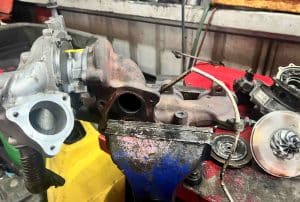
Nissan_Navara_NP300_Twin_turbo
Seized or sticky actuators.
Oil leaks into the intake or downpipe.
Boost lag or underboost conditions are flagged on scan tools.
These issues typically point to internal CHRA (centre housing rotating assembly) wear — not complete turbo destruction. And that opens the door to a much smarter option: CHRA replacement or turbo rebuild.
CHRA Replacement – The Midpoint Most Workshops Ignore
If the compressor and turbine housings are still in good condition (i.e. no cracks, no bent blade marks, no salt corrosion), a CHRA swap is a valid and reliable fix. Here’s how the numbers shake out:
New OEM turbos (x2) + labour: ~$6,000 plus -installed.
Aftermarket replacements (x2, e.g. Jrone (we are Jrone dealers in Australia) or equivalent) + labour: ~$4,200–$5,000 installed
Rebuild with new CHRAs + labour: ~$3,500 (approx) installed.
At Brisbane Tuning & Turbo, we often recommend this middle path — particularly when actuator function is intact and the turbo housing passes our inspection. We fit new high-quality CHRAs (balanced and tested), clean or replace oil lines, reassemble using upgraded seals and gaskets, and reinstall with fresh oil and filters. You get a fully operational twin-turbo setup — at nearly half the dealer price.
How It Compares: NP300 vs Prado Turbo Jobs
To give you a frame of reference, let’s look at the Toyota Prado 1KD. It’s a single VNT turbo setup. Turbo replacement on a Prado usually lands around $3,200. That’s for a complete turbo replacement, with less than half the labour of an NP300 job.
So while both engines are similar in size and use, the NP300’s twin turbo layout doubles the parts and nearly triples the labour — making rebuilds an even more valuable option in this platform.
When Rebuilds Make Sense (And When They Don’t)
A rebuild or CHRA replacement is ideal if:
Your turbos have got shaft play, minor oil leaks, or bearing noise.
Your turbo actuator is still functional (we’ll test it for you).
There’s no damage to the exhaust manifold or turbine housing.
You’re towing, touring, or just daily driving — not chasing performance peak power.
But sometimes, full turbo replacement really is necessary. We recommend it when:
The housings are cracked or warped.
The compressor or turbine wheels are damaged from debris.
There’s saltwater corrosion or pitting (common on beach rigs).
You want to upgrade to an aftermarket performance setup.
Navara NP300 Twin Turbo Mix Rebuild
At Brisbane Tuning & Turbo, we are proud of being able to save our customers money by using our knowledge, and we don’t like to throw new parts during repairs if there is a way of reusing the existing, good original part. If one turbo, for example, needs a full replacement, yet the other can be rebuilt to make the whole job cost less, we recommend this solution to our customers. If, however, the customer says – let’s just replace both, then we replace both, yet we always offer an educated option if there is one.
Why Dealers Always Push Full Replacement
It’s no secret — dealerships don’t rebuild. In fact they don’t have the skills, knowledge and most importantly, equipment as we have at Brisbane Tuning & Turbo. They follow fixed part replacement guidelines and rarely deviate. That’s not a dig; it’s just the model they operate under. But for you, the owner, it means less flexibility and zero effort made to salvage what’s still working. Which is why the default quote is always “two new turbos and six grand plus, mate.”
At Brisbane Tuning & Turbo, we take a different approach.
Can You Keep Driving With This Problem?
In the early stages, the vehicle may still drive normally.
But continued driving — especially under load — will:
– increase heat
– worsen internal wear
– push the turbo from repairable → replacement
The earlier it’s diagnosed, the more you can save.
What Brisbane Tuning & Turbo Offers
We start every turbo job the same way: with a proper diagnostic. That means:
Full scan to log codes and actuator behaviour.
A smoke test – to eliminate ripped hoses.
Dyno test to check live boost curve and load response. This allows us to “clock” the actuator’s behaviour. (Often, a dead actuator can be the result of wrong turbocharger diagnostics.)
Visual inspection and leak-down if needed.
From there, we’ll show you whether you actually need a full replacement — or if a rebuild is a smarter option, yet this option can only be definitively confirmed once we take the turbochargers off. And we’ll give you pricing for both, upfront, so you’re not making decisions blind.
We don’t quote based on worst-case assumptions. We quote based on what we find and what we can fix.
What You Get After Your Diagnostic
– confirmation of which turbo is failing
– actuator condition
– repair vs replacement decision
– exact cost before work begins
Frequently Asked Questions
– Do both turbos need replacing?
That will depend on the condition of the small turbocharger.
– Can I replace just one turbo?
If the larger turbocharger isn’t affected, then yes.
– Is rebuild reliable?
Absolutely.
– What causes NP300 turbo failure?
Long servicing intervals, contaminated oil, dirty air filter, actuator failure, blocked vacuum lines.
What Happens Over Time
Week 1–2: boost lag
Month 1: noise / inconsistency
Month 2: oil leaks / actuator issues
Later: turbo failure
Worried About Your Navara NP300 Twin Turbo Problems?
Don’t Guess.
If your Navara is down on power, smoking under load, or has thrown a boost-related fault code, don’t panic — and definitely don’t just hand over six or seven grand without getting it properly checked. Get a second opinion, even if it means you have to spend money on a tow truck.
Book your diagnostic scan + dyno session with Brisbane Tuning & Turbo today and get the real story behind your twin-turbo issue. You might be surprised at what can actually be saved — and how much you could avoid spending.
After all, if you really have a lot of money, you can always donate, mate, help real people, not the dealerships 😉