Nissan Pathfinder R52 CVT Transmission Problems
Nissan Pathfinder R52 CVT Transmission Problems (2013–2021) Common Faults, Symptoms & Repairs.
Let’s start by understanding the Nissan Pathfinder R52 CVT.
The 2013–2021 Nissan Pathfinder R52 is fitted with the Jatco JF017E continuously variable transmission (CVT). It varies the ratio continuously using two pulleys connected by a high-strength steel chain.
Although the design is quite different from a traditional automatic, the basic goal is exactly the same—transferring engine torque to the wheels as efficiently and smoothly as possible.
The main components inside the JF017E include:
Torque converter
Primary pulley
Secondary pulley
Steel chain
Hydraulic pump
Valve body with electronic solenoids
Transmission Control Module (TCM)
When you accelerate, engine torque passes through the torque converter into the primary pulley. The steel chain transfers that torque to the secondary pulley, which then drives the differential and wheels. Please read our article Nissan CVT Transmission Problems if you want to learn more.
What makes a CVT different
What makes a CVT different is that both pulleys can change diameter hydraulically. As one pulley becomes larger, the other becomes smaller. Instead of shifting between first, second or third gear, the transmission continuously adjusts the ratio to keep the engine operating in its most efficient range.
Everything depends on hydraulic pressure.
The valve body controls the oil pressure throughout the transmission. That pressure moves the pulleys, applies the torque converter lock-up clutch and, most importantly, clamps the steel chain tightly between the pulley faces.
If hydraulic pressure is correct, the chain grips the pulleys securely and the transmission operates smoothly.
If pressure drops—even slightly—the chain can begin slipping across the pulley faces. At first, the driver may only notice a slight shudder or hesitation. Internally, however, the slipping creates heat and starts wearing the hardened pulley surfaces.
As the pulleys wear, fine metal particles contaminate the transmission fluid. That contamination passes through the valve body and solenoids, reducing hydraulic performance even further. The result is a cycle where a small hydraulic problem gradually develops into significant internal transmission damage.
Because Nissan Pathfinder JF017E relies so heavily on hydraulic pressure, many different faults can produce similar symptoms. A shudder, delayed engagement or transmission warning light doesn’t automatically mean the transmission needs replacing. Identifying the actual cause of the problem is the first step towards selecting the correct repair.
Which Nissan Pathfinder Models
This article applies to the Nissan Pathfinder R52 manufactured between 2013 and 2021 and fitted with the Jatco JF017E CVT transmission.
It covers both 2WD and 4WD models equipped with the 3.5-litre VQ35DE V6 petrol engine.
Although Nissan used different transmission calibration and selector codes throughout the production run, the operating principles, common failure patterns and diagnostic approach remain largely the same.
If you’re unsure which transmission is fitted to your Pathfinder, our workshop can identify it using your VIN or transmission identification label before recommending any repairs. Please call us to discuss your Pathfinder CVT symptoms and to book it in for CVT diagnostics.
Why Nissan Pathfinder R52 CVT Transmissions Fail?
Most JF017E transmissions don’t fail because of one catastrophic event. In most cases, the damage develops gradually. A small hydraulic problem can eventually lead to major internal wear if it isn’t diagnosed early.
Loss of hydraulic pressure.
One of the most common causes is loss of hydraulic pressure.
The JF017E relies on hydraulic pressure to move the pulleys, apply the torque converter lock-up clutch and clamp the steel chain between the pulley faces. The valve body and its electronic solenoids control this pressure.
As components wear or become contaminated, hydraulic pressure may no longer remain within specification. When this happens, the chain cannot grip the pulleys with enough force and may begin slipping under load.
Even slight chain slip creates heat and starts wearing the hardened pulley faces. As the pulleys wear, they produce fine metal particles that circulate through the transmission fluid.
This contamination passes through the entire transmission, including the valve body, oil pump and solenoids. Over time, hydraulic performance deteriorates further, allowing internal damage to accelerate.
Torque converter wears.
The torque converter is another common source of problems.
As the lock-up clutch wears, it can cause a shudder during light acceleration or cruising. The worn friction material contaminates the CVT fluid, adding to the debris already circulating through the transmission.
Heat also plays a major role.
High operating temperatures reduce the fluid’s ability to maintain stable hydraulic pressure and accelerate wear of seals, bearings and other internal components.
The important point is that these failures are often connected.
A worn valve body.
A worn valve body can reduce hydraulic pressure.
Reduced pressure allows the chain to slip.
Chain slip wears the pulleys.
Worn pulleys contaminate the fluid.
Contaminated fluid causes further wear inside the valve body.
Once this cycle begins, the transmission condition can deteriorate quickly.
For this reason, two Pathfinder transmissions with similar symptoms may require completely different repairs. One may only need valve body repairs, while another may already have significant internal damage requiring a complete rebuild. A proper diagnosis determines where the failure started and which repair is most appropriate.
Common Symptoms of a Failing Nissan Pathfinder CVT
The JF017E doesn’t usually fail overnight. In many cases, the transmission gives warning signs long before a major failure occurs. Recognising these symptoms early may allow the problem to be diagnosed before significant internal damage develops.
Shudder During Acceleration
One of the most common complaints is a shudder or vibration when accelerating, particularly under light to moderate throttle.
Depending on the cause, this may be related to torque converter lock-up, hydraulic pressure loss or wear of the chain and pulleys. Although the symptoms can feel similar, the repair required can be very different.
Delayed Engagement
If there is a noticeable delay when selecting Drive or Reverse, the transmission may be struggling to build hydraulic pressure quickly enough.
Possible causes include valve body wear, internal leakage or excessive internal wear. This symptom should not be ignored, as it often indicates that hydraulic performance is deteriorating.
Engine RPM Increases Without Matching Acceleration
If the engine revs increase but the vehicle doesn’t accelerate normally, the transmission may not be transferring torque efficiently.
This can occur when the steel chain slips on the pulleys or when hydraulic pressure is insufficient to maintain the correct clamping force.
Whining or Humming Noise
A whining noise that changes with vehicle speed may indicate bearing wear, oil pump problems or internal transmission wear.
Although some CVT operating noise is normal, any new or progressively louder noise should be investigated.
Transmission Overheating
Excessive transmission temperature reduces the effectiveness of the CVT fluid and can accelerate internal wear.
Some vehicles may illuminate a transmission warning light or enter a reduced-power mode to help protect the transmission from further damage.
Warning Lights and Fault Codes
The transmission control module continuously monitors the operation of the CVT.
If it detects abnormal hydraulic pressure, incorrect pulley ratios or electrical faults, it may store diagnostic trouble codes and illuminate the transmission warning light.
A fault code is an important starting point, but it does not automatically identify the failed component. The same code may be caused by a valve body fault, internal wear, hydraulic leakage or another underlying problem.
Common Nissan Pathfinder CVT Fault Codes
Some of the more common fault codes on the JF017E include:
P17F0 – CVT Judder (Severe Deterioration)
Usually indicates that the transmission has detected significant judder. Internal inspection is often required to determine the extent of the damage.
P17F1 – CVT Judder (Deterioration Detected)
Often indicates the early stages of transmission deterioration. Depending on the cause and how long the vehicle has been driven with the fault, repairs may range from valve body work to a complete rebuild.
P0746 – Pressure Control Solenoid Performance
May indicate a hydraulic control problem involving the valve body, pressure control system or contamination affecting solenoid operation.
P0841 – Transmission Fluid Pressure Sensor
Usually indicates that the measured hydraulic pressure is outside the expected operating range. Further testing is required to determine why.
P0868 – Low Hydraulic Pressure
Indicates the transmission is unable to maintain sufficient line pressure. Possible causes include valve body wear, internal leakage or mechanical wear.
P2813 – Pressure Control Solenoid
Commonly relates to the pressure control system and requires further diagnosis before any components are replaced.
A common mistake is assuming that a fault code identifies the failed part. In reality, the transmission control module only reports what it has detected—not why it happened.
For example, low hydraulic pressure may be caused by a worn valve body, a sticking solenoid, internal leakage, pump wear or significant internal transmission damage. The fault code points the technician in the right direction, but further testing is required to identify the root cause.
For this reason, we always recommend diagnosing the transmission before replacing parts. It is the most reliable way to determine what has failed and what repair is actually required.
How Does the Transmission Control Module Detect a Fault?
The Transmission Control Module (TCM) cannot see worn pulleys, a slipping chain or internal transmission damage. Instead, it continuously compares information from multiple sensors to determine whether the transmission is operating as expected.
For example, the TCM monitors engine speed, primary pulley speed, secondary pulley speed, transmission fluid pressure, throttle position and fluid temperature. It then compares the actual transmission ratio with the ratio it has commanded.
If the measured ratio differs from the expected ratio, or hydraulic pressure falls outside the acceptable range, the TCM may store a fault code or place the transmission into a failsafe mode.
This is why a fault code should be viewed as the beginning of the diagnostic process rather than the final diagnosis. The TCM reports what it has detected, but further testing is required to determine why the fault has occurred.
Can a CVT Fluid Change Fix the Problem?
It depends on what has caused the fault. Yet if you were recommended a “triple flush” – don’t waste your money; fresh CVT fluid won’t “grow” or regenerate damaged parts.
Replacing the CVT fluid is an important maintenance procedure and can help protect the transmission from premature wear. However, fresh fluid cannot repair worn mechanical or hydraulic components.
If the transmission has developed valve body wear, chain slip, pulley damage or a worn torque converter lock-up clutch, changing the fluid alone will not correct the problem.
In some cases, replacing old fluid in a severely worn transmission may temporarily improve shift quality or reduce shudder, but this should not be mistaken for a permanent repair.
The most effective approach is to diagnose the transmission first. Once the root cause has been identified, it becomes much easier to determine whether the transmission simply requires servicing, a valve body repair, or a complete rebuild.
Repair Options for the Nissan Pathfinder R52 CVT
Not every Pathfinder with a CVT problem requires a complete transmission replacement or rebuild. The correct repair depends on what has failed and how much secondary damage has occurred.
After carrying out a transmission diagnosis, the repair may involve one of the following.
Valve Body Repair or Replacement
If the problem is confined to the hydraulic control system and there is no evidence of significant internal wear, repairing or replacing the valve body may restore correct hydraulic pressure and transmission operation.
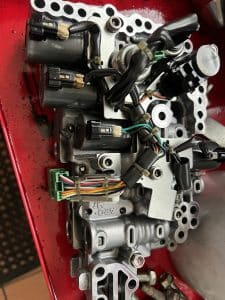
Valve Body Nissan Pathfinder
However, fitting a valve body to a transmission with worn pulleys or a slipping chain is unlikely to solve the problem.
Torque Converter Repair
If the lock-up clutch has worn and is causing a shudder, the torque converter may need to be rebuilt or replaced.
It’s also important to determine whether the converter is the only failed component or whether contamination has already affected the rest of the transmission.
Complete CVT Rebuild
If the transmission has developed chain slip, pulley damage or excessive internal wear, a complete rebuild is usually the most reliable repair.
During a rebuild, worn and damaged components are replaced, the transmission is thoroughly cleaned, and the hydraulic system is inspected to ensure contamination has been removed before reassembly.
Why One Pathfinder May Need a Valve Body While Another Needs a Complete Rebuild
Two Nissan Pathfinders can arrive at our workshop with identical symptoms, yet require completely different repairs.
Both vehicles may have a shudder during acceleration and store the same fault code. In one transmission, the problem may be limited to the valve body or hydraulic control system. In another, the transmission may have already developed chain slip, pulley wear and metal contamination.
The difference is often how long the transmission has been driven after the first symptoms appeared.
This is why we don’t recommend quoting repairs based on symptoms or fault codes alone. A proper diagnosis determines where the failure started and whether the transmission can be repaired without a complete rebuild.
Can a Nissan Pathfinder CVT Be Repaired?
In many cases, yes.
The earlier a fault is identified, the greater the chance of preventing more extensive internal damage. A shudder, delayed engagement or transmission warning light should never be ignored simply because the vehicle is still driving.
Continuing to drive with a developing fault can allow minor hydraulic problems to progress into chain, pulley and bearing damage, significantly increasing the cost of repair.
| Symptom | Possible Cause |
|---|---|
| Shudder | Torque converter, chain slip, valve body |
| Delayed Drive | Hydraulic pressure loss |
| High RPM | Chain slip, pulley wear |
| Whining | Bearings, oil pump |
| P17F1 | Hydraulic or internal wear |
| P0868 | Low hydraulic pressure |
Can I Continue Driving With a Failing CVT?
It depends on the fault, but in most cases we do not recommend continuing to drive a Pathfinder once the transmission develops a noticeable shudder, delayed engagement or transmission warning light.
Many JF017E failures begin as hydraulic problems. If hydraulic pressure falls below specification, the steel chain can start slipping on the pulley faces. The longer the transmission continues to operate in this condition, the greater the risk of internal wear and metal contamination.
What may initially require a valve body repair can eventually progress to chain and pulley damage, significantly increasing the cost of repair.
If you notice a change in the way your Pathfinder drives, arranging a transmission diagnosis as soon as possible gives you the best chance of identifying the problem before more extensive damage occurs.
How to Prevent Nissan Pathfinder CVT Problems
While no transmission lasts forever, there are several steps that can help maximise the service life of the JF017E CVT.
Service the transmission regularly. Over time, CVT fluid degrades and becomes contaminated with normal wear particles. Replacing the fluid at appropriate intervals helps maintain hydraulic performance and lubrication. Our view, in Queensland a CVT should be serviced every 30,000 km. Due to heat and type of use.
Use the correct CVT fluid. The JF017E is designed to operate with a specific type of CVT fluid. Using the wrong fluid can affect hydraulic pressure, pulley clamping force and overall transmission performance.
Don’t ignore early symptoms. A slight shudder, delayed engagement or transmission warning light may seem minor, but these are often the first signs of a developing problem. Diagnosing the fault early may help prevent more extensive internal damage.
Avoid excessive transmission heat. High operating temperatures accelerate fluid degradation and internal wear. If your Pathfinder is regularly used for towing or heavy loads, maintaining the transmission cooling system becomes even more important. We recommend installing an external cooler on all heavy working Pathfinders.
Diagnose faults before replacing parts. Many CVT symptoms can have multiple causes. A professional diagnosis helps identify the root cause of the problem and reduces the risk of replacing components unnecessarily.
How We Diagnose Pathfinder CVT Problems
At Brisbane Tuning & Turbo, we don’t diagnose a transmission based on a fault code alone.
Our diagnosis may include:
- Road testing the vehicle.
- Scanning the transmission control module for fault codes.
- Analysing live transmission data.
- Inspecting the condition of the transmission fluid.
- Assessing the valve body and hydraulic system.
- Determining whether the fault is hydraulic, mechanical or electronic.
The purpose of the diagnosis is to identify the root cause of the problem before recommending any repair.
The Jatco JF017E used in the Nissan Pathfinder R52 is a sophisticated transmission that relies on accurate hydraulic control to operate correctly. Like any automatic transmission, wear can develop over time, but not every fault means the transmission needs replacing.
An accurate diagnosis is the key to determining whether the problem is related to the valve body, torque converter or internal transmission components. Identifying the fault early can often prevent more extensive damage and help avoid unnecessary repairs.
At Brisbane Tuning & Turbo, we don’t replace transmissions based on assumptions. We diagnose the cause first, explain our findings, and then recommend the most appropriate repair. Whether your Nissan Pathfinder requires valve body repairs, a torque converter, or a complete CVT rebuild, our goal is to identify the real fault before any major repair begins.
Exchange CVT Transmissions Available
At Brisbane Tuning & Turbo, we keep selected rebuilt Nissan Pathfinder R52 JF017E CVT transmissions in stock, ready for exchange.
If your transmission has suffered significant internal damage, or a replacement is simply a more practical option than rebuilding your existing unit, fitting an exchange transmission can often get your vehicle back on the road much sooner.
We supply exchange CVT transmissions to independent mechanics and workshops throughout Australia. If you’re a mechanical workshop looking for a professionally rebuilt JF017E transmission, contact us to discuss availability, compatibility and freight options. Please read our Nissan CVT Transmission Problems article to learn more about CVT problems.
Every transmission is professionally rebuilt using quality components and thoroughly inspected before leaving our workshop, giving both vehicle owners and repairers confidence in the replacement unit. Please complete the form below to get in touch or just call us.