Ranger Injector Failure Pattern
Black Smoke, Rising Oil Level, and One Dead Cylinder — The Ford Ranger Injector Failure Pattern
Ranger Injector Failure Pattern- some Ford Rangers come into the workshop still running, still driving, still towing — but something isn’t right. There’s black smoke under load. The oil level keeps creeping up between services. The engine feels slightly rough, like one cylinder isn’t pulling its weight. No warning lights. No dramatic breakdown.
Most owners treat these as separate issues.
They’re not. These are Ranger Injector Failure Pattern.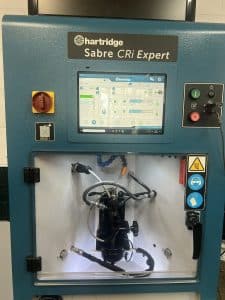
When these symptoms appear together, they usually point to a specific injector failure pattern that, if ignored, quietly damages pistons and turns a manageable problem into a major engine failure.
Why symptom clusters matter more than fault codes
Modern engines are very good at hiding problems. The ECU compensates, trims fueling, and smooths things out until it can’t anymore. That’s why fault codes are often absent in the early and middle stages of injector-related failures.
What matters more than a single warning light is pattern recognition. When black smoke, oil dilution, and one underperforming cylinder appear together, they are rarely coincidental. They are the engine telling you that combustion is no longer controlled evenly across all cylinders.
Understanding that pattern early is the difference between prevention and rebuild.
What black smoke is really telling you
Black smoke is unburnt or poorly burned fuel. It’s not “dirty diesel,” and it’s not automatically a tuning issue.
Ranger Injector Failure Pattern In Rangers, black smoke under load often means one or more injectors are delivering fuel in a way the combustion chamber can’t burn cleanly. That can be too much fuel, poor atomisation, delayed injection, or a spray pattern that no longer distributes fuel evenly.
At this stage, the engine often still feels strong. That’s what makes it dangerous. Excess fuel creates heat in the wrong places.
Why oil levels rise when injectors misbehave
Rising oil level is one of the most overlooked warning signs in diesel engines. The question to ask – what is going wrong and HOW?
When an injector overfuels or loses spray control, excess diesel can wash down the cylinder walls. That fuel bypasses the rings and ends up in the sump. The oil level rises, but oil quality drops.
Fuel-diluted oil lubricates poorly and removes heat less effectively from pistons and rings. That increases friction, raises temperatures, and accelerates wear exactly where the engine can least afford it.
Oil dilution is not a maintenance issue. It’s an engine survival issue.
The “one dead cylinder” clue
Injector problems rarely affect all cylinders equally. One injector drifting, sticking, or bypassing fuel internally will usually show up as one cylinder behaving differently.
This can feel like a mild misfire, uneven idle, or vibration under load. On diagnostics, it often appears as one cylinder contributing less or correcting more than the others — without triggering a classic misfire fault code.
That single cylinder is where damage usually begins.
How these symptoms combine to damage pistons
On their own, each symptom is concerning. Together, they form a clear failure path.
Overfueling creates localised heat.
Oil dilution reduces lubrication and piston cooling.
One cylinder running differently concentrates stress on one piston instead of spreading it evenly across the engine.
That piston crown runs hotter. Aluminium softens. Rings lose control. Microscopic cracks or scuffing begin. If the vehicle continues towing or working in this condition, piston failure becomes a matter of time, not luck.
This is the middle stage of failure — often still reversible if addressed correctly.
Why guessing makes this pattern worse
When these symptoms appear, guessing is the most expensive response.
Changing oil repeatedly treats the symptom, not the cause. Replacing one injector without testing can increase imbalance. Tuning around smoke can raise combustion temperatures even further. Ignoring it because the engine still runs is how pistons die quietly.
Injector problems cannot be solved by assumptions. Every wrong guess adds risk.
The Brisbane Tuning & Turbo diagnostic process: proving the pattern
At Brisbane Tuning & Turbo, we treat this symptom cluster as a diagnostic problem, not a parts problem.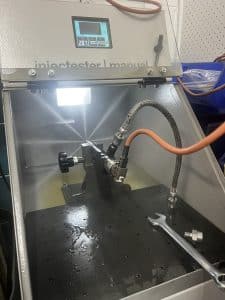
The process starts by confirming the pattern, not chasing one symptom. Injector balance testing shows how each cylinder contributes under different conditions. Return flow analysis reveals injectors that are bypassing fuel internally instead of delivering it properly. Oil checks confirm whether fuel dilution is already occurring.
From there, controlled load testing shows how injector behaviour changes when the engine is actually working — towing, accelerating, or holding sustained load. This is where many injector faults finally reveal themselves.
Each step answers a different question. Skipping any of them leads to incomplete conclusions.
Why load testing matters more than idle checks
Many injector problems look harmless at idle. Under load, they become destructive.
As fueling demand increases, weak injectors lose control. Injection duration stretches. Combustion temperatures spike. The exact conditions that damage pistons appear — and only load testing captures that.
This is why engines that “idle fine” still fail on the highway or towing uphill.
How early diagnosis changes the outcome
Vehicles caught at this stage often avoid engine damage entirely.
Correcting injector behaviour, restoring oil quality, adjusting calibration where needed, and reducing thermal stress through cooling improvements can stabilise the engine before pistons crack.
Vehicles that keep driving in this condition usually don’t get that chance. By the time a cylinder drops compression, the conversation shifts from prevention to engine builds.
The difference is timing — and evidence.
Where tuning and cooling corrections fit
Once injector health is confirmed, tuning and cooling changes become tools for protection, not risk.
Corrected calibration ensures fueling matches injector capability. Cooling and thermal management reduce piston stress under load. These steps are about reliability, not chasing numbers.
They only make sense once injector behaviour is known.
Patterns tell the truth before engines fail
Black smoke, rising oil level, and one underperforming cylinder are not random issues. They’re a pattern — and patterns exist for a reason.
If your Ford Ranger shows these signs, the engine is giving you information early. Listening to it with proper diagnostics often saves pistons, engines, and a lot of money.
Guessing rarely does.
If you want clarity before a mid-failure turns into a full rebuild, that’s the point where proper diagnostics matter most.